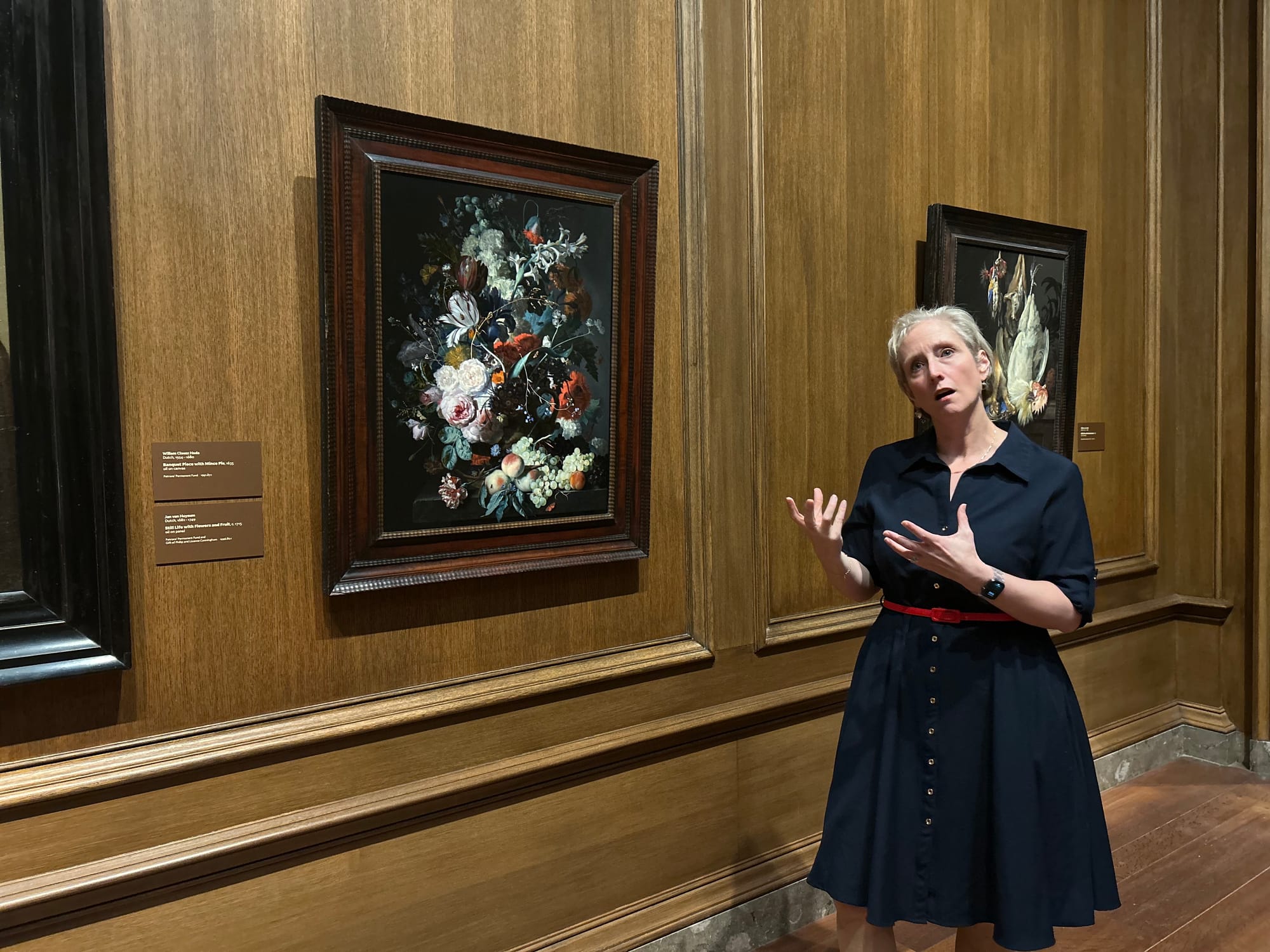
Lorena Bradford might not be a household name, but she really should be. The first head of Accessible Programs at the National Gallery of Art (NGA) in Washington, DC, Bradford started monthly tours in American Sign Language, established a program for individuals with memory loss, and brought in medical students to learn soft skills to apply in their caregiving.
"I was a sub-department of one," she joked to writer Emma Cieslik, who spoke with Bradford over Zoom and at the NGA about her own circuitous path into the profession, and the future of the field of museum accessibility. The Trump administration, of course, has taken its toll, but she's hopeful for the future.
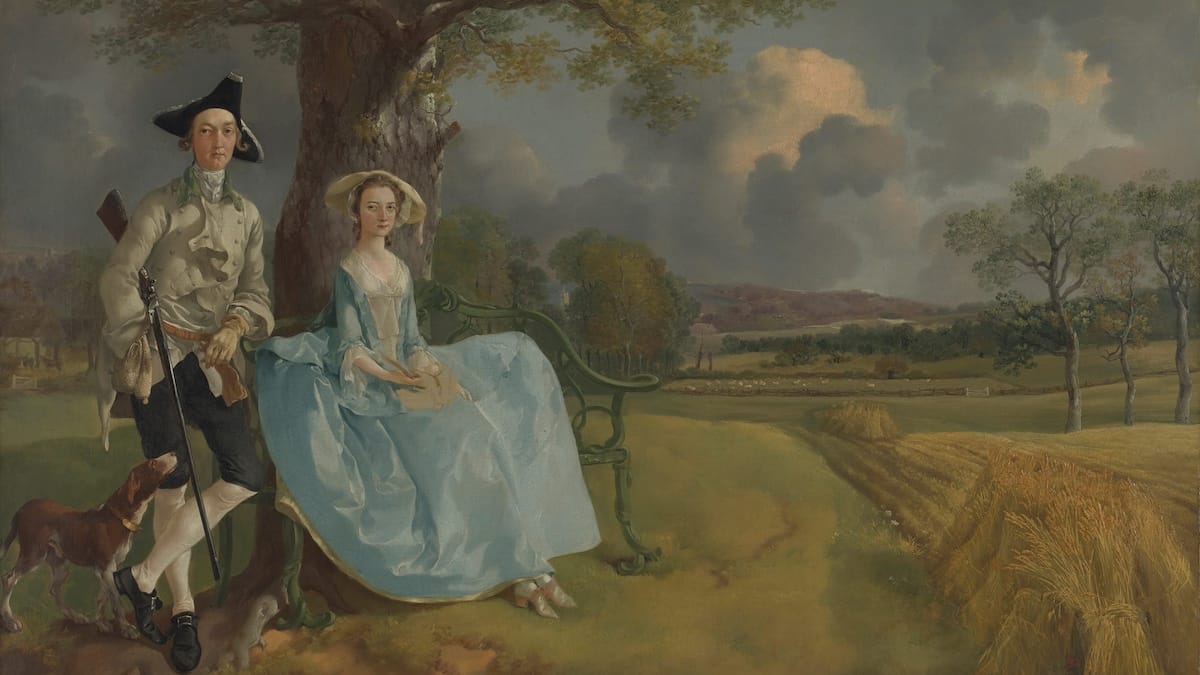
Also today, we've got something of a mini fashion issue — Eileen Isagon Skyers walks us through the 18th-century stylings of Thomas Gainsborough (think: Pride and Prejudice), and Associate Editor Lakshmi Rivera Amin proves that the sartorial is political in a feature on the history of the sari in New York City.
—Lisa Yin Zhang, associate editor
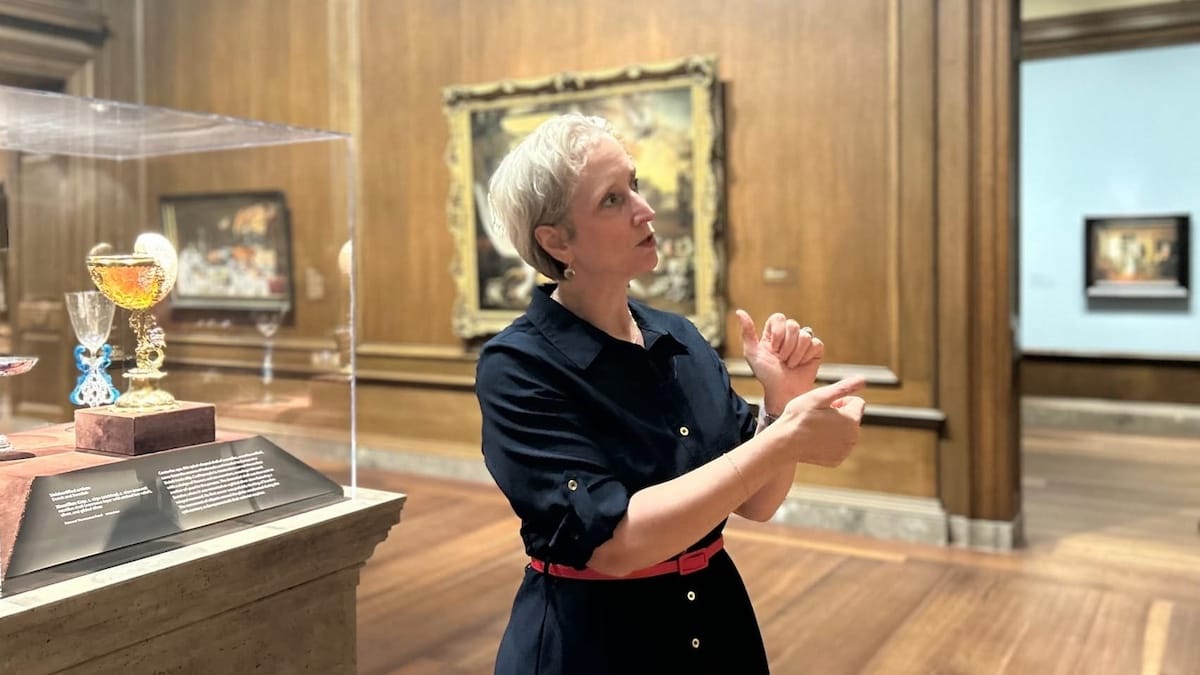
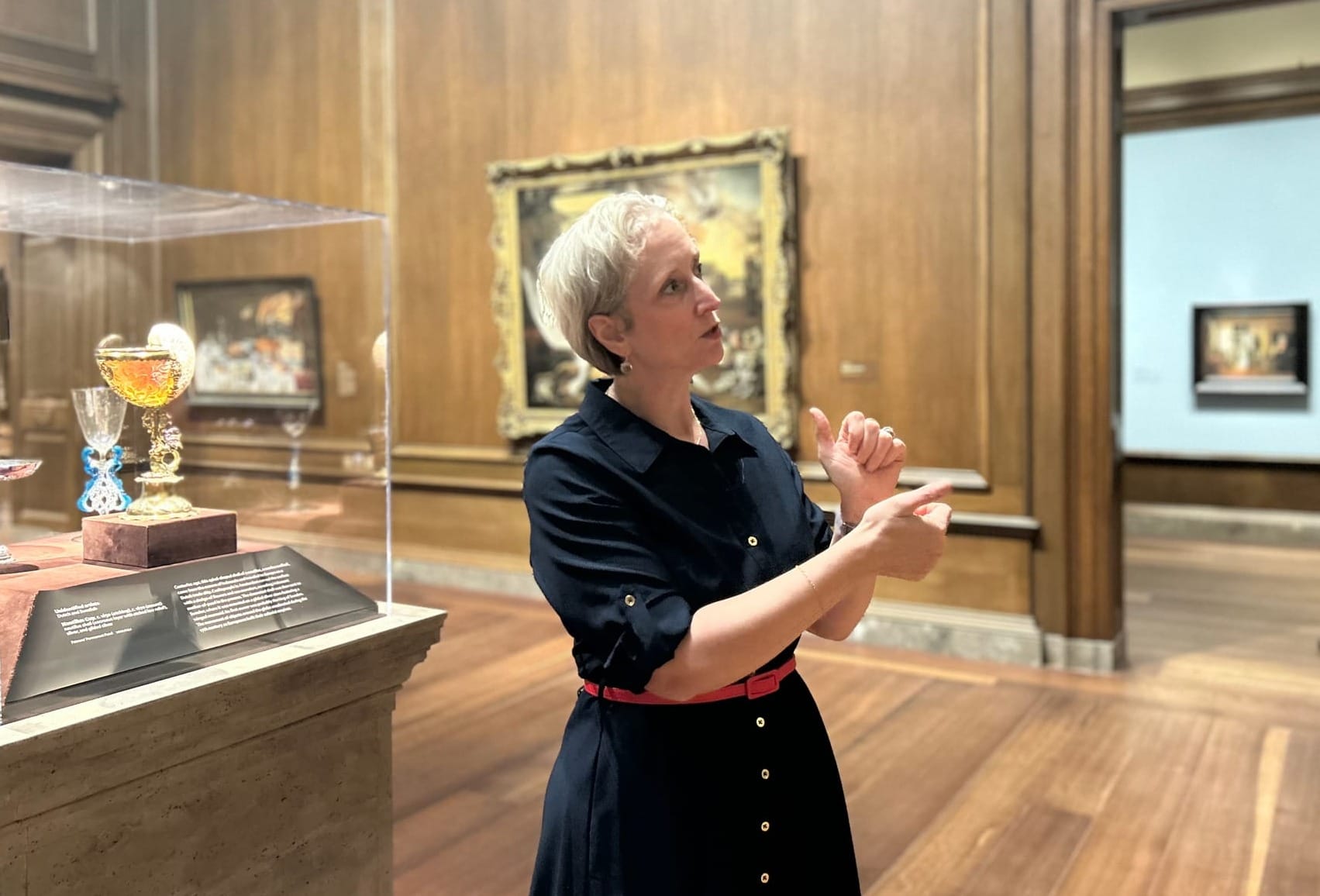
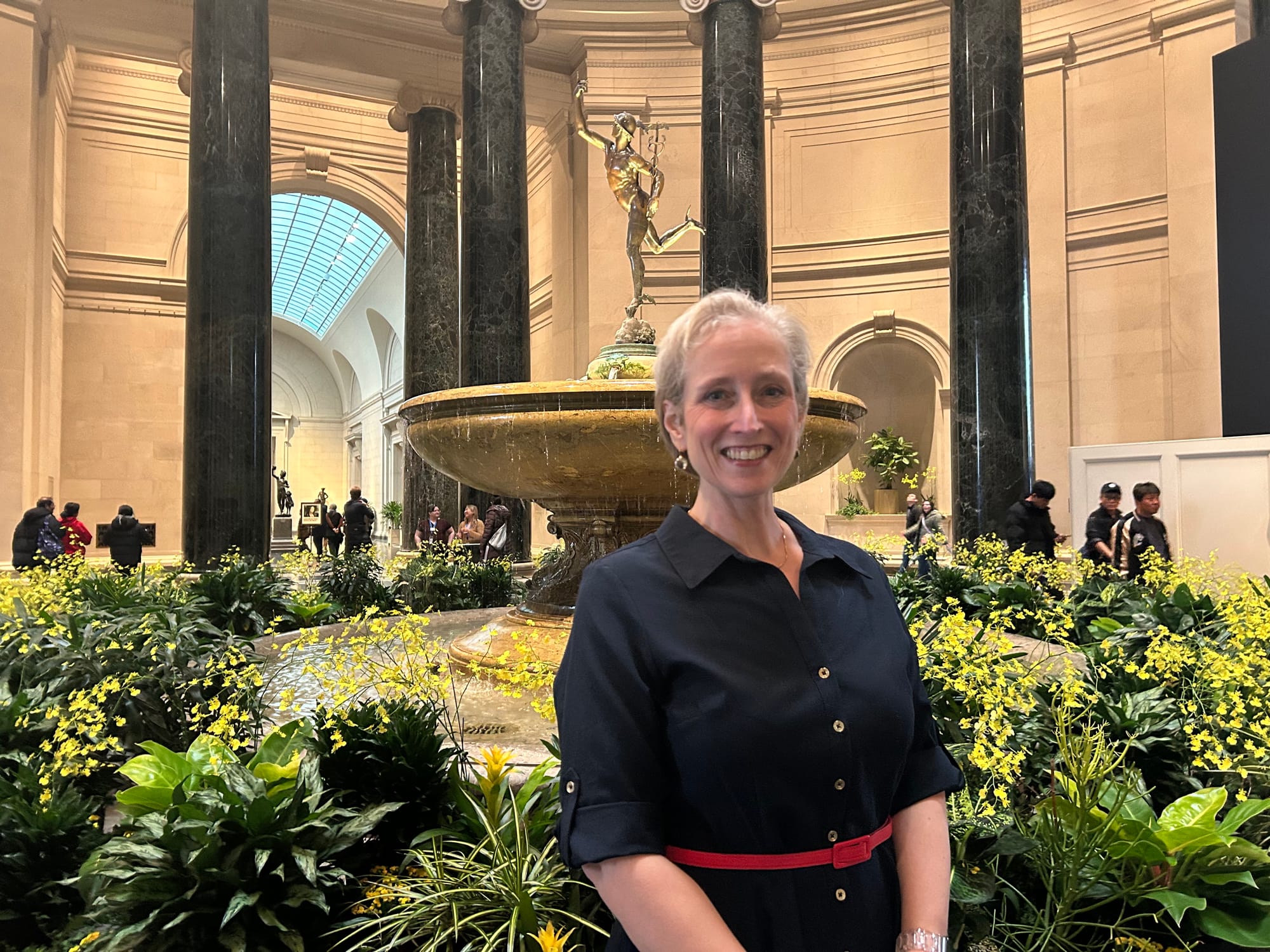
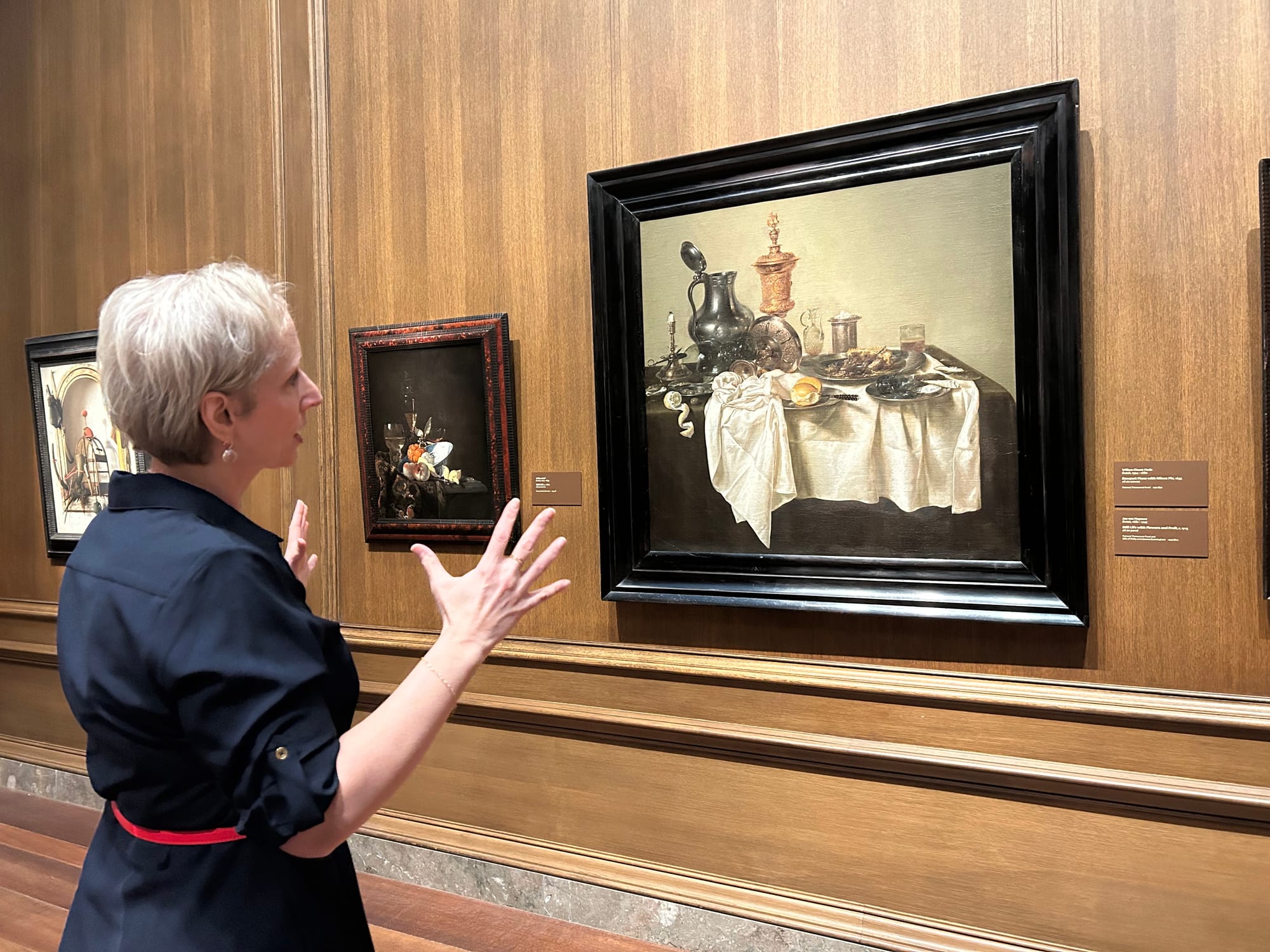
Lorena Bradford at the National Gallery of Art in 2025 (photo Emma Cieslik/Hyperallergic)
The first head of Accessible Programs at the National Gallery of Art tells us about her path and the future of museum accessibility. | Emma Cieslik
SPONSORED
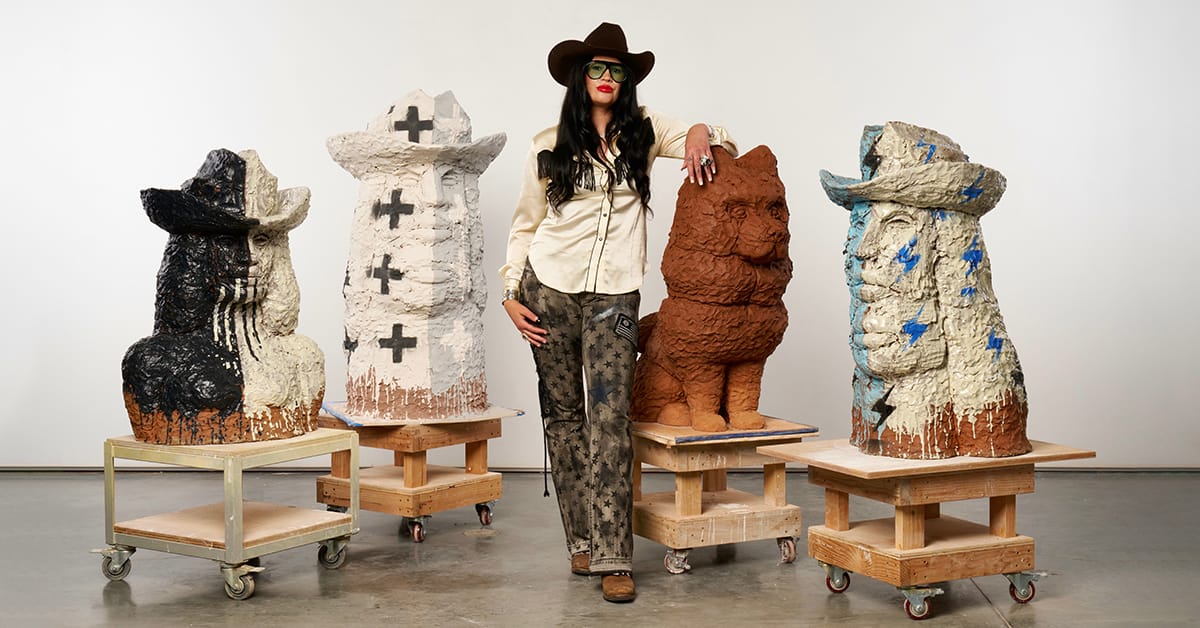
Raven Halfmoon: Flags of Our Mothers
Ballroom Marfa presents the first major traveling exhibition by Raven Halfmoon, featuring colossal sculptures that honor the artist’s Caddo Nation ancestors. On view May 1–October 11, 2026. Join us opening weekend, May 1–2, for an artist talk, a community meal by Chef Nico Albert, and live music by Night Beats.
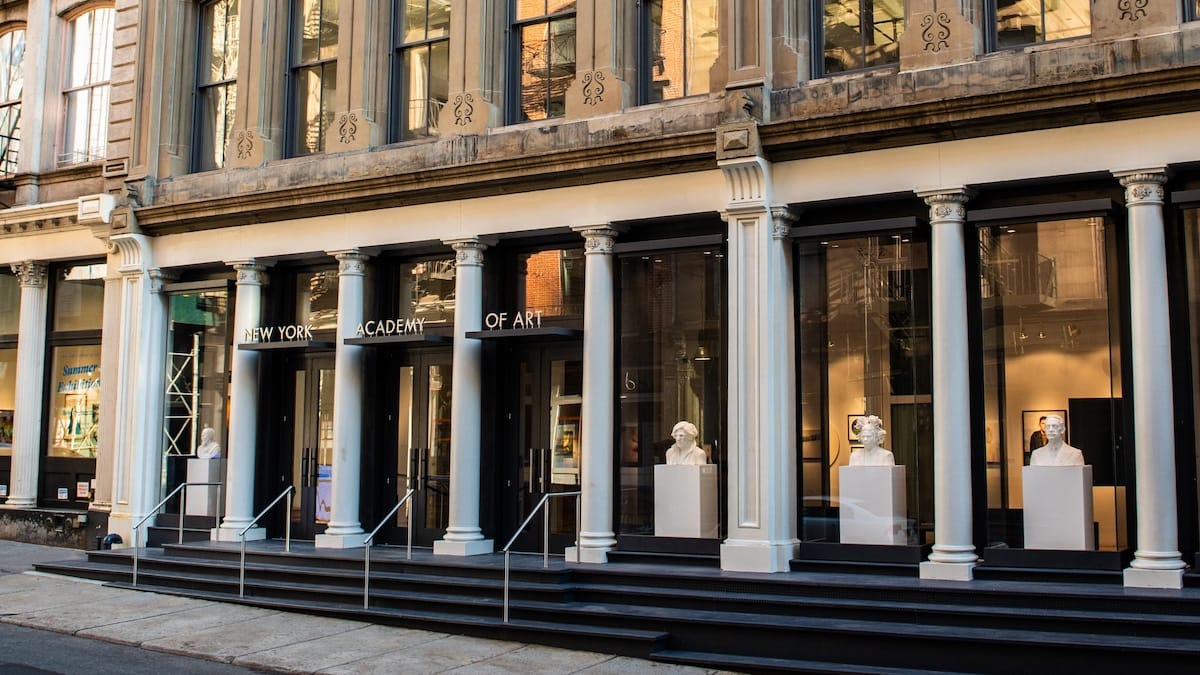
Exterior view of New York Academy of Art (photo courtesy NYAA)
Last week, the New York Academy of Art told its students and alumni that it will donate $65,900 in funds associated with sex offender Jeffrey Epstein to an organization supporting survivors of sex trafficking.
Painted during summer trips to the Channel coast, Seurat intended his seascapes to “cleanse one’s eyes of the days spent in the studio." | Olivia McEwan
SPONSORED
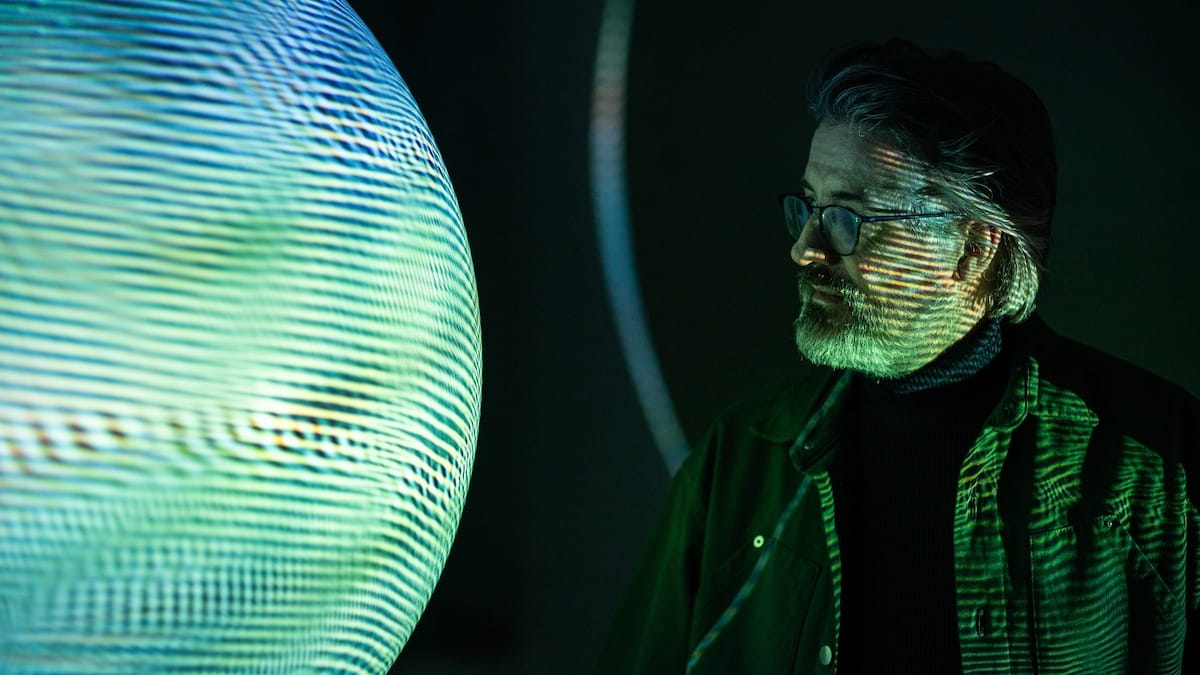
Olafur Eliasson: A symphony of disappearing sounds for the Great Salt Lake
As the lake’s ecological crisis worsens, the artist’s new site-specific installation in Salt Lake City renders audible what is increasingly at risk of vanishing.
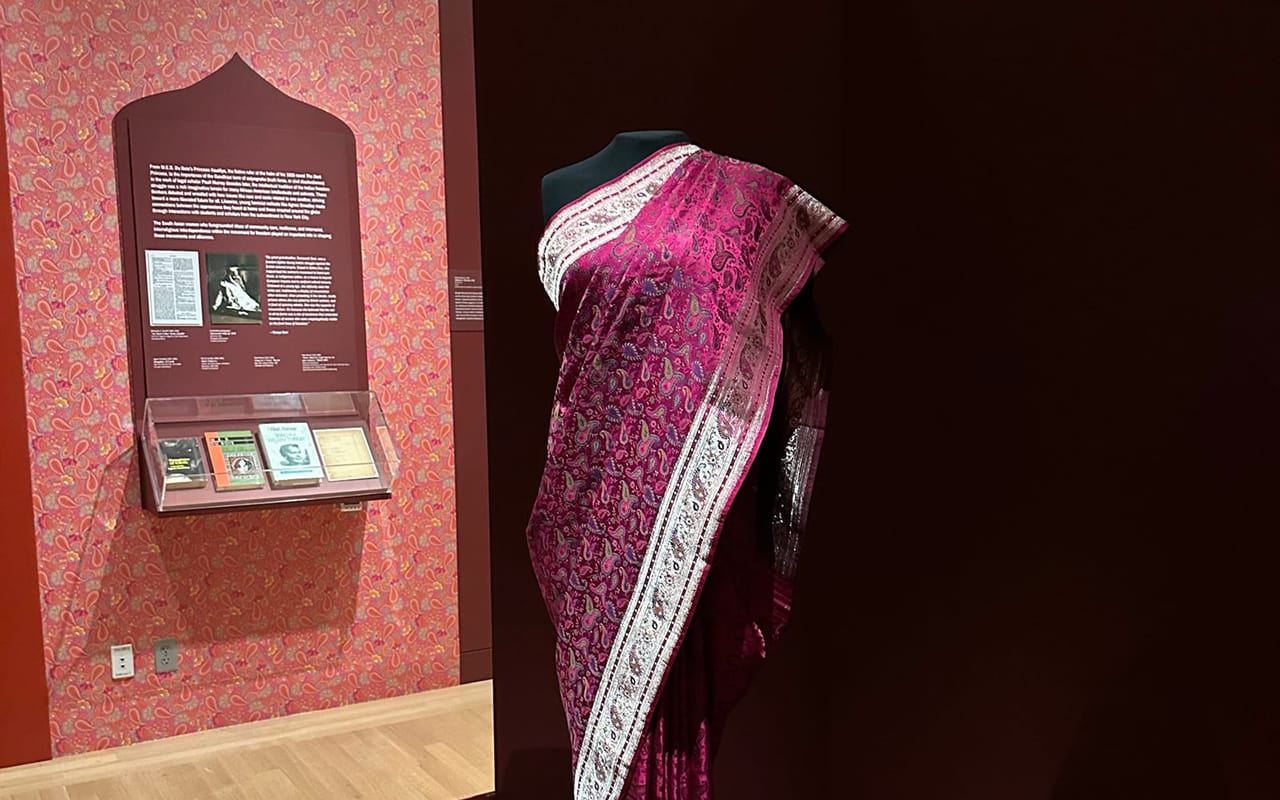
At the New York Historical, an exhibition reminds us that the sari is a living art form, an heirloom, a document, and a political statement in one. | Lakshmi Rivera Amin
ICYMI
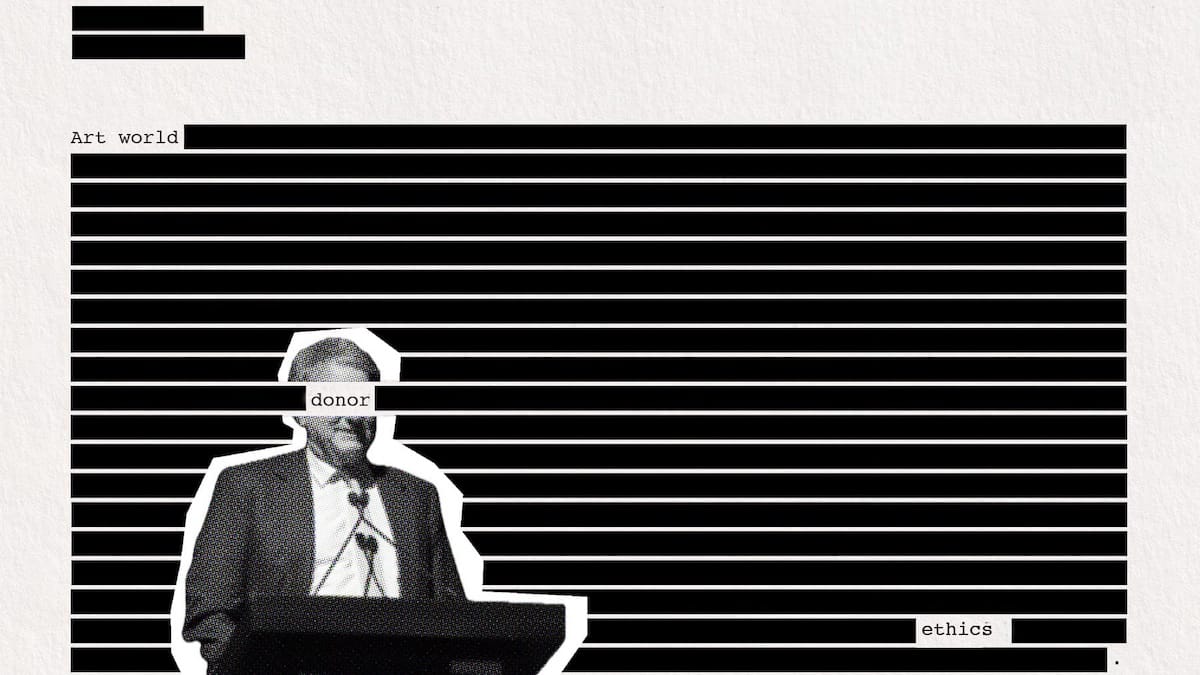
The culture that Jeffrey Epstein represents is deeply embedded in the art establishment power structures. (edit Shari Flores and Hrag Vartanian/Hyperallergic)
How do we empower arts leaders to reject funding from corrupt individuals in favor of donors who have proven themselves to be civic leaders? | Hrag Vartanian
In the grand list of authors who would call me a slur and yet whom I still read, I hold it against Georgette Heyer more than Lovecraft, since she lived through WW2, but less than Dahl, since he fought in WW2 and still thought this shit. Just the calculus I do.
Shakespeare, on the other hand, would have turned philosemitic the second he found out there were Jewish theatrical producers because that’s how that man rolled.
In the grand list of authors who would call me a slur and yet whom I still read, I hold it against Georgette Heyer more than Lovecraft, since she lived through WW2, but less than Dahl, since he fought in WW2 and still thought this shit. Just the calculus I do.
Genuine question: is there an instruction manual for that?
Do you find beauty in darker themes of literature and art?
Or music that expresses melancholy?
Or music that has themes of the macabre, the unnatural, or darkness? (Or maybe vampires.)
Do you appreciate dramatic aesthetics?
Congratulations, you can consider yourself a goth. Or goth-adjacent. Yes, there’s the wide range of clothing, makeup, and aesthetics that you can explore (and I 100% encourage you to do that), but you don’t have to. While goth has a lot of visual signifiers, it’s the things I listed above that are key to the goth mindset.
Shameless Self-Promotion time! For more help and information, you could go purchase a copy of Gothic Charm School: An Essential Guide for Goths and Those Who Love Them.
Gothic Charm School, just like my username. 😁
Might as well continue the shameless self-promotion and reblog this. :)
FYI, some of the information or references may be outdated, as the book was published in 2009. (aaaaaah linear time freaks me out!)
There’s also the Gothic Charm School site, with all sorts of other articles! The last update was in May of last year; I’m hoping to return to writing and updating the site, but migraines and my chronic health issues keep thwarting my attempts.
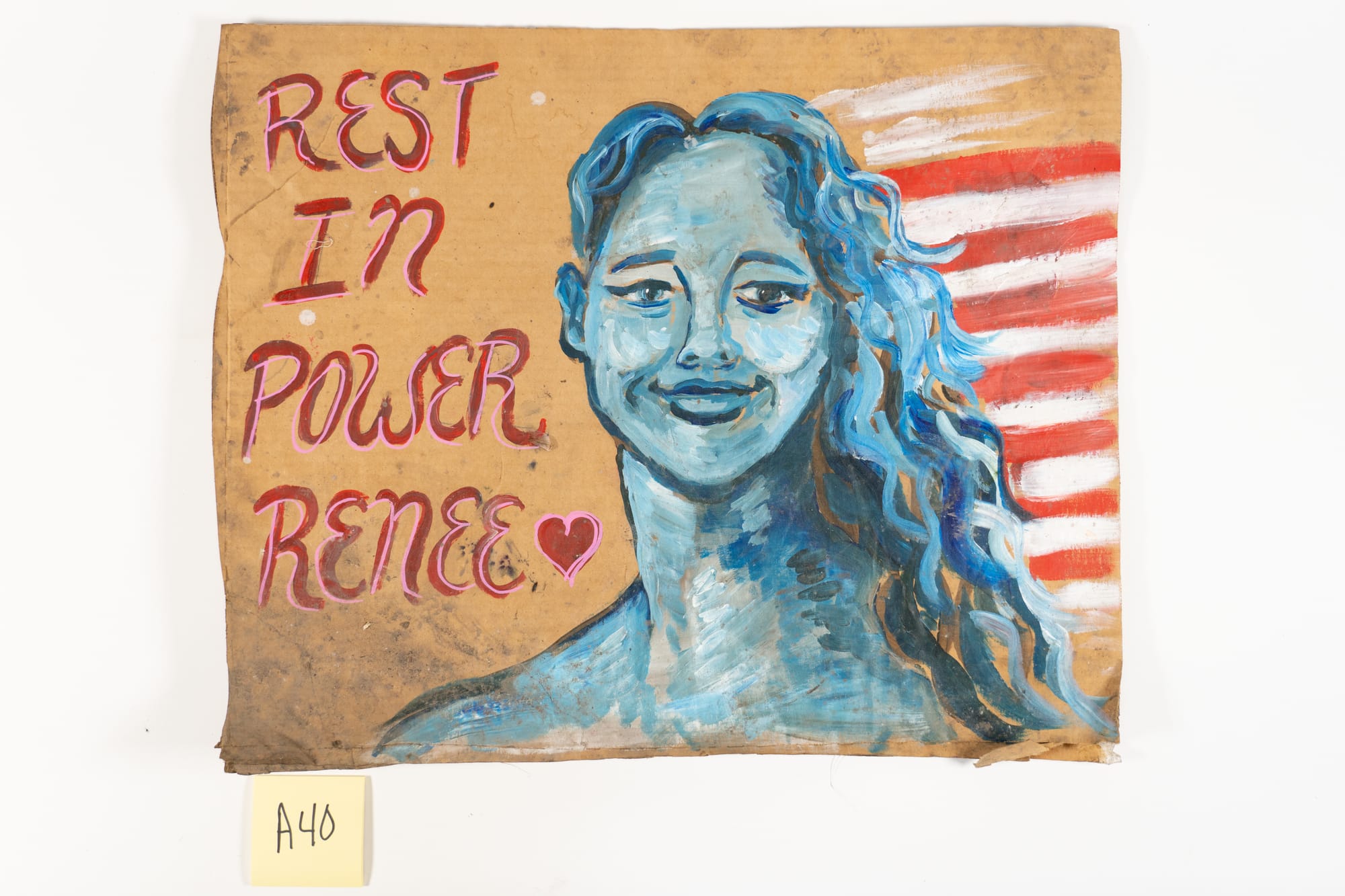
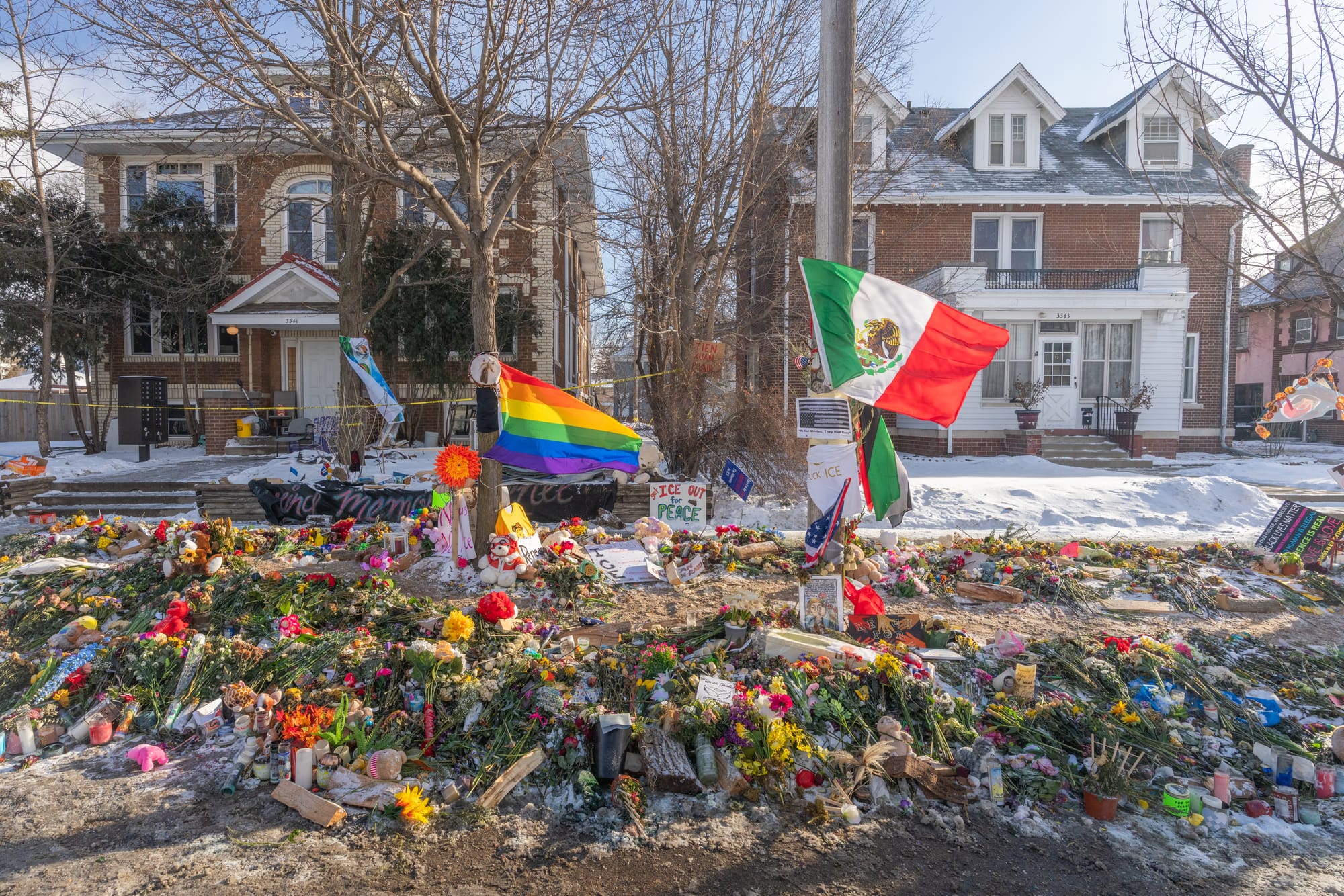
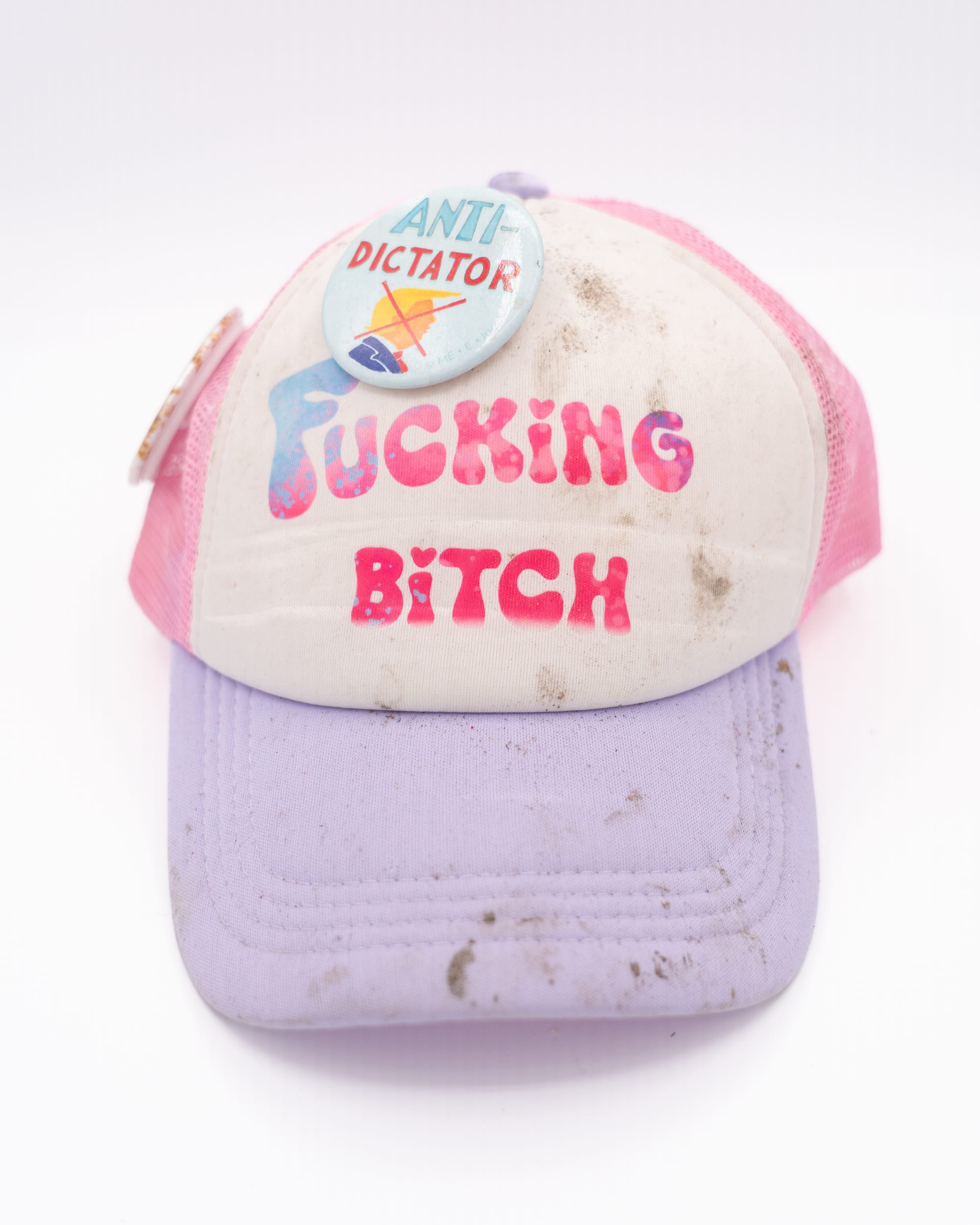
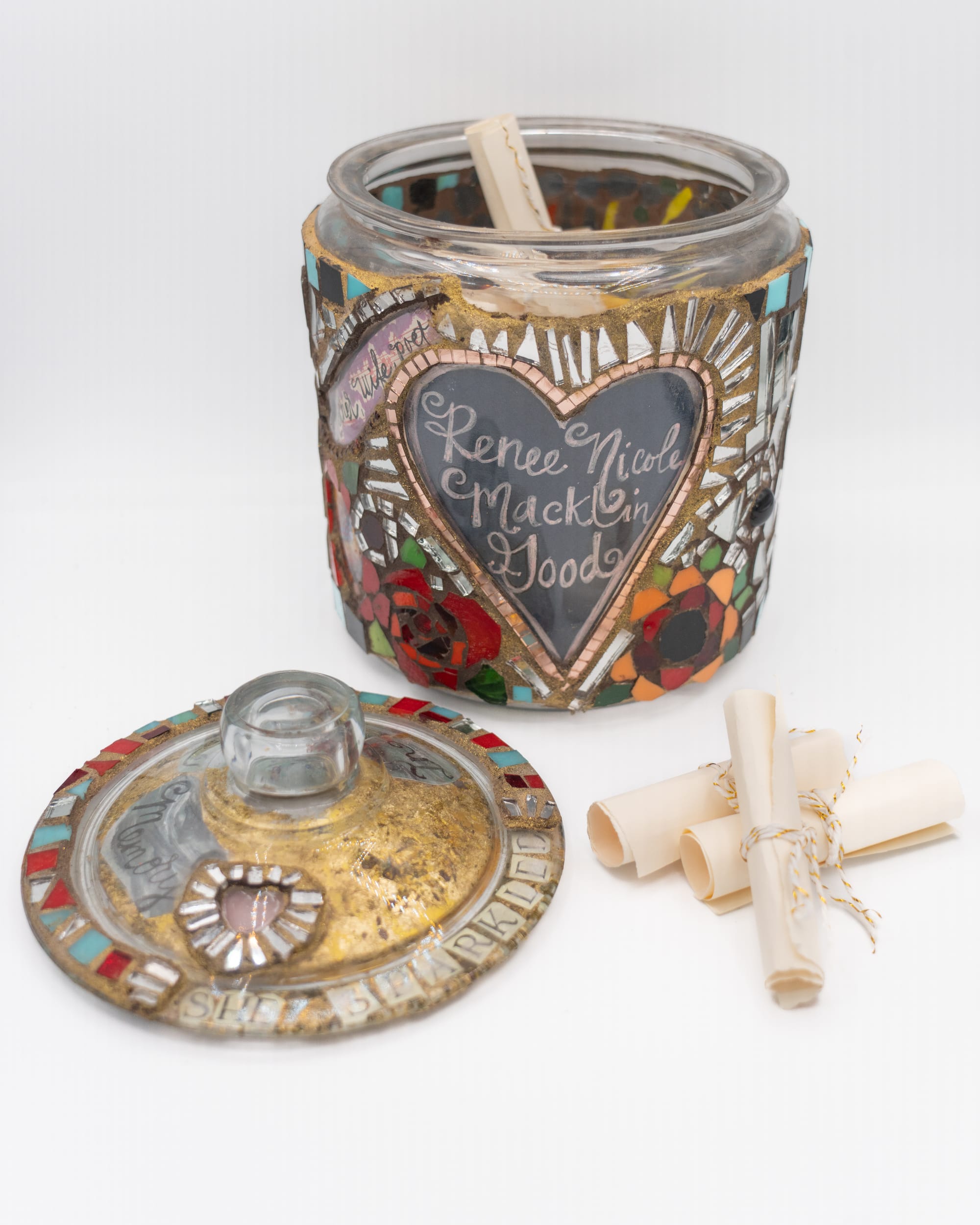
Ryan Vizzions is archiving the objects left at the site of Renee Good's murder. (all photos by and courtesy Ryan Vizzions)
Ryan Vizzions, a photojournalist from Atlanta, had already arrived in Minnesota when federal immigration agents murdered poet and mother Renee Nicole Macklin Good.
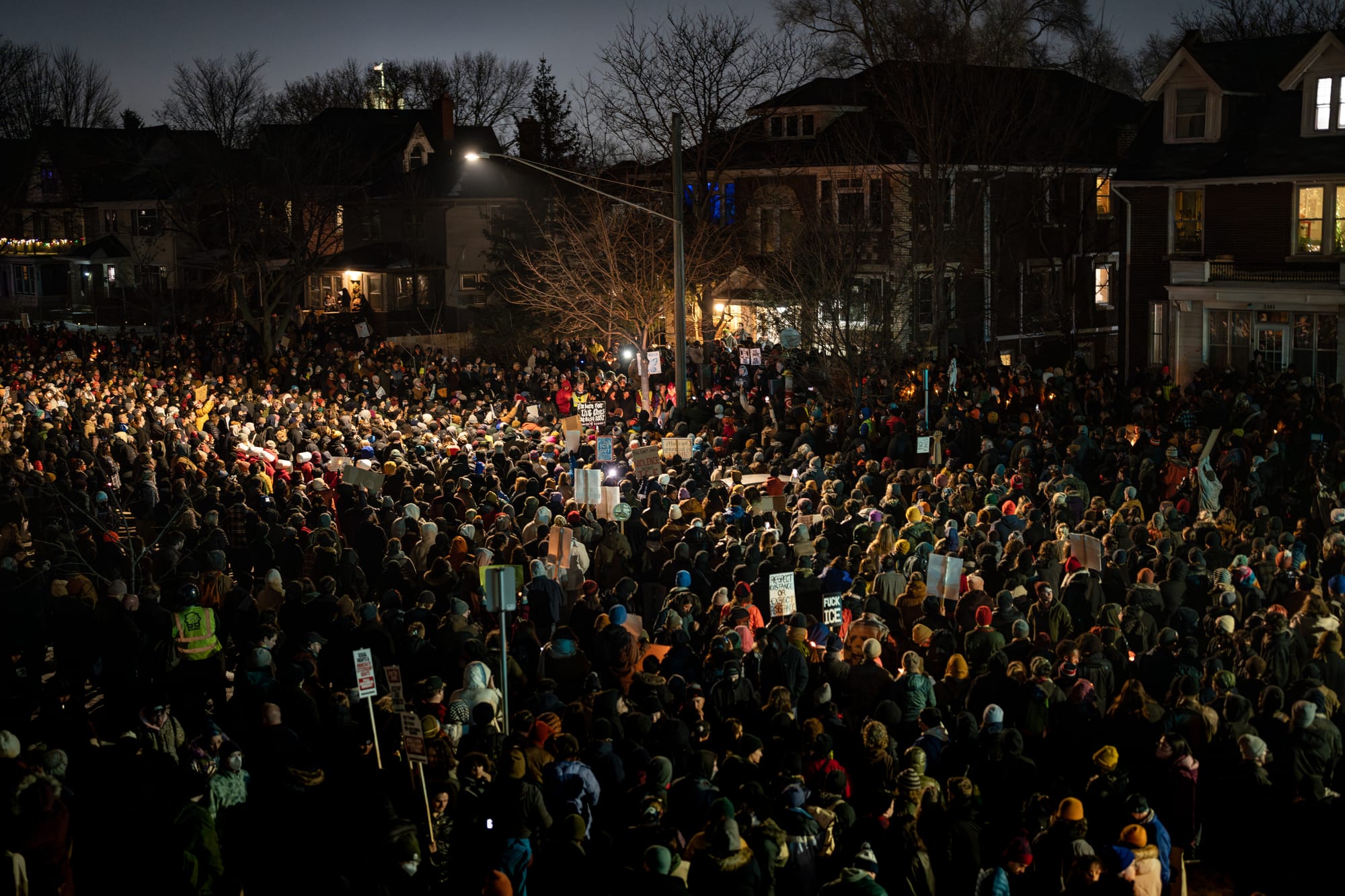
For the last five years, the traveling photographer has been living out of his small van as he travels across the country for a photo survey exploring what it means to be American in all 50 states. He was taking photos at Lake Superior when he learned of Good’s killing, and drove immediately to the street where agents shot Good in her car. He arrived in time for a massive vigil held in Good’s memory.
Nearly two months after Good’s murder, Vizzions is still in Minnesota, but his focus has shifted from observation to intervention. He is now the de facto archivist of Good’s memorial site, where mourners have left hundreds of devotional objects, short notes, and artwork in protest and in grief.
"I want to make sure people in the future understand what happened here,” Vizzions told Hyperallergic in an interview.
Vizzions among Good memorial objects at his undisclosed storage site
So far, Vizzions has photographed about 200 items and relocated fragile objects to what he described as a “secret location” in the southern part of the city.
He’s left behind some items, including plastic signs, for the public to view. Alongside community members, Vizzions is maintaining the site, including by removing what he described as hundreds of pounds of decaying flowers.
Among the items Vizzions has documented is a note signed by an employee of the Department of Homeland Security (DHS), the agency driving the Trump administration’s escalating immigration enforcement tactics.
“Ms. Good,” the message reads, “We will never forget you. Rest in peace and power. Your work on earth is done. Your legacy lives on.”
The card, which is covered in stickers, is signed, “A DHS employee.”
“That was probably the most surprising because that's somebody who is involved with the same institution that ultimately killed her,” Vizzions told Hyperallergic.
Flowers at Renee Good's memorial siteMourners attended a vigil for Good hours after federal agents killed her.
Vizzions made the leap from outside observer to active participant in Minneapolis’s response to Good’s murder after someone attempted to burn the memorial site and extreme winter conditions set in, threatening to destroy the makeshift monument.
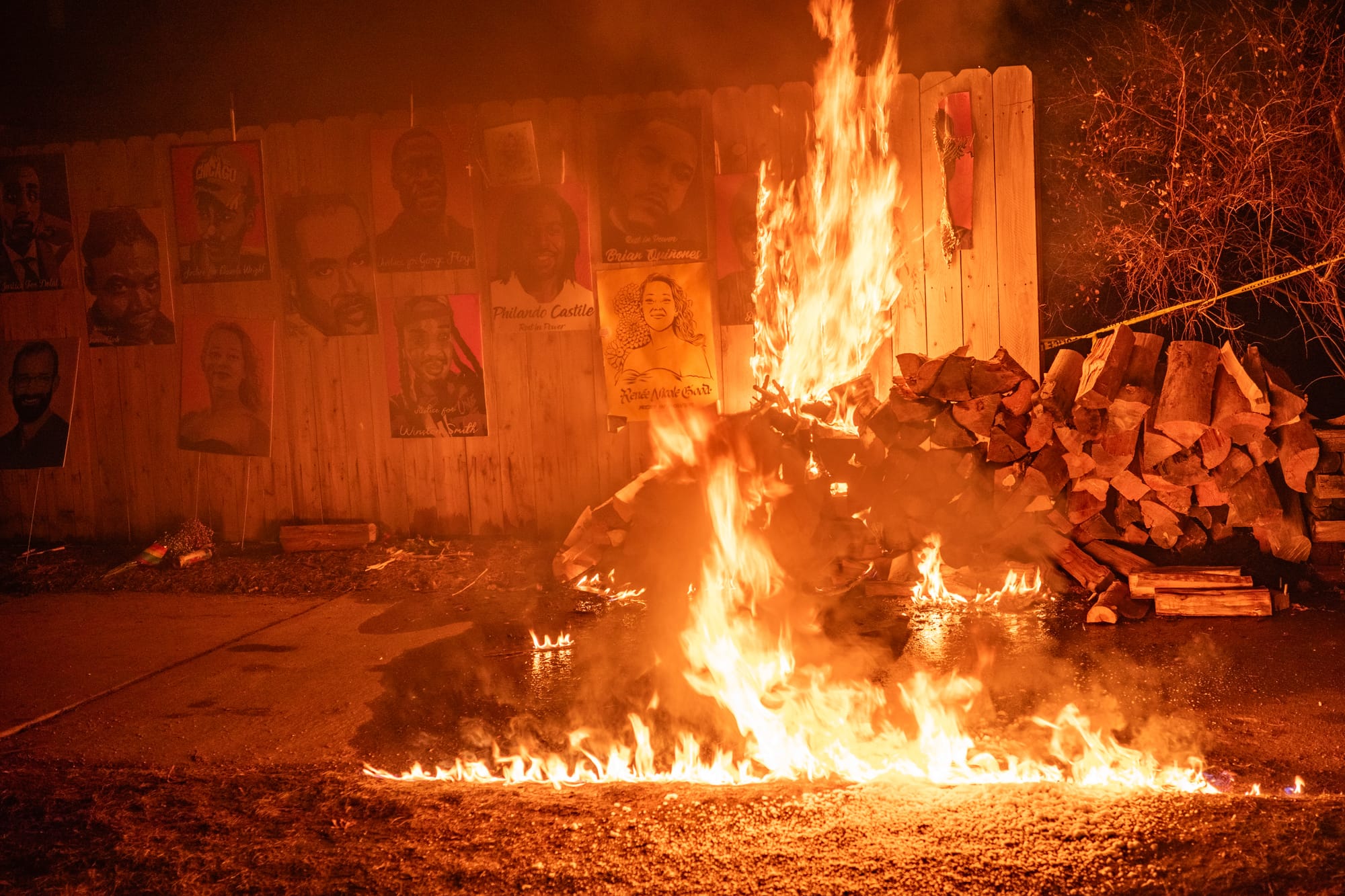
On February 18, someone poured gasoline on the memorial and lit a flame. Vizzions said that he and a group of community members watching over the siteat night were able to stop the fire from spreading.
While Vizzions has previouslyphotographed political apexes, including Dakota Access Pipeline protests at Standing Rock, he said he had never before inserted himself in the communities he covers.
“ As a photojournalist, oftentimes you're divided from the community because you’re on the outside looking in,” Vizzions said. “And I wanted to serve.”
Vizzions was watching over the site in February when someone poured gasoline and set fire to the memorial
Vizzions told Hyperallergic that Good’s parents are aware of his project and that he is in communication with a family friend who is serving as a mediator. Ultimately, Vizzions said, he will respect the family’s wishes for any next steps for the collection. He expects that some of the items could end up in the collections of private institutions or in the archives of the Smithsonian, but noted that whatever happens next will not be his decision to make.
In the meantime, he is photographing and digitizing items from Good's vigil so that anyone can experience them, regardless of where they live.
"It's really important for me to make sure that the folks who couldn't be here, and the family who couldn't come to the vigil because of everything happening, are able to access the memorial in person or online," Vizzions said.
As he waits for the family to direct his next move, Vizzions is digitizing the collection of memorial objects.
The photographer recalled one snow-covered note that made him cry. It read: “ We all carry whistles now. I hope you hear them. I hope you're home. We all carry each other now. I know you're with us. I know you're home.”
The message is a nod to activists' use of whistles to alert community members of potential immigration raids.
"It was just on a small note that was tucked somewhere," Vizzons said. "But that's just one of hundreds, if not thousands, of items that people have left. It's that message and the other message that really make it feel like we have an obligation to protect these offerings that people brought to her."
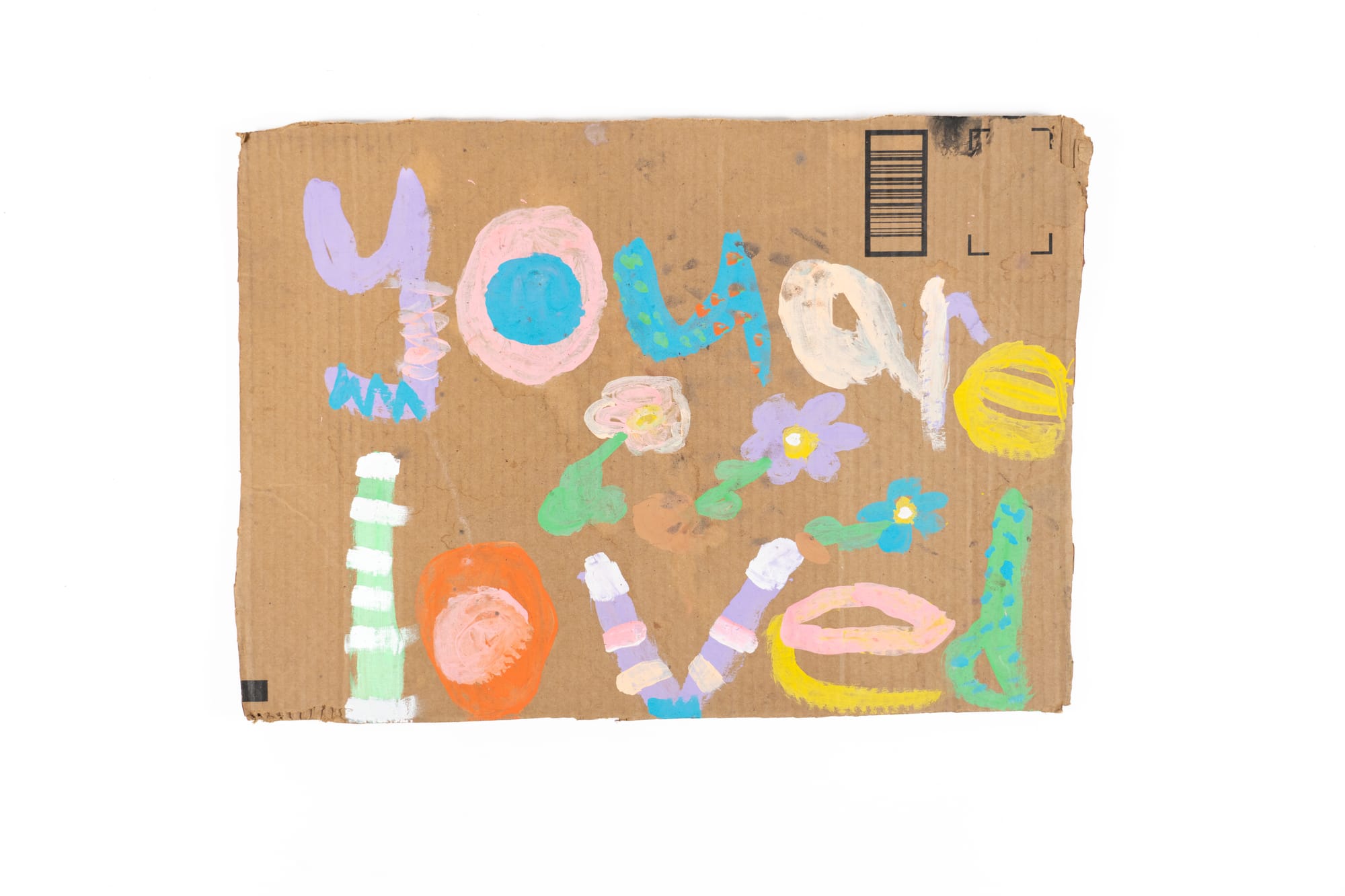
Vizzions collected this candle at the memorialA hat left behind at the Renee Good memorial siteA jar of unopened notes that Vizzions has stored.
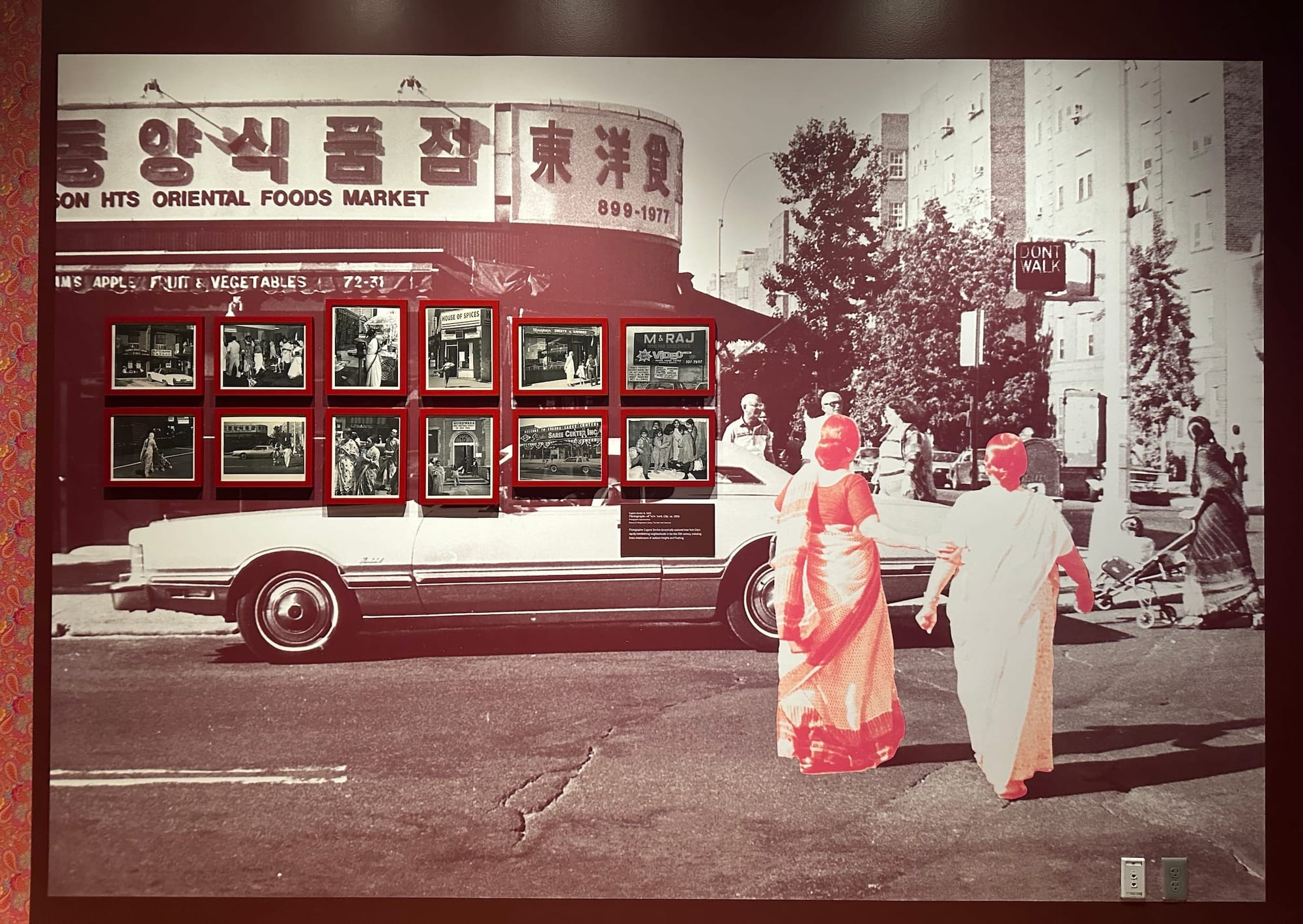
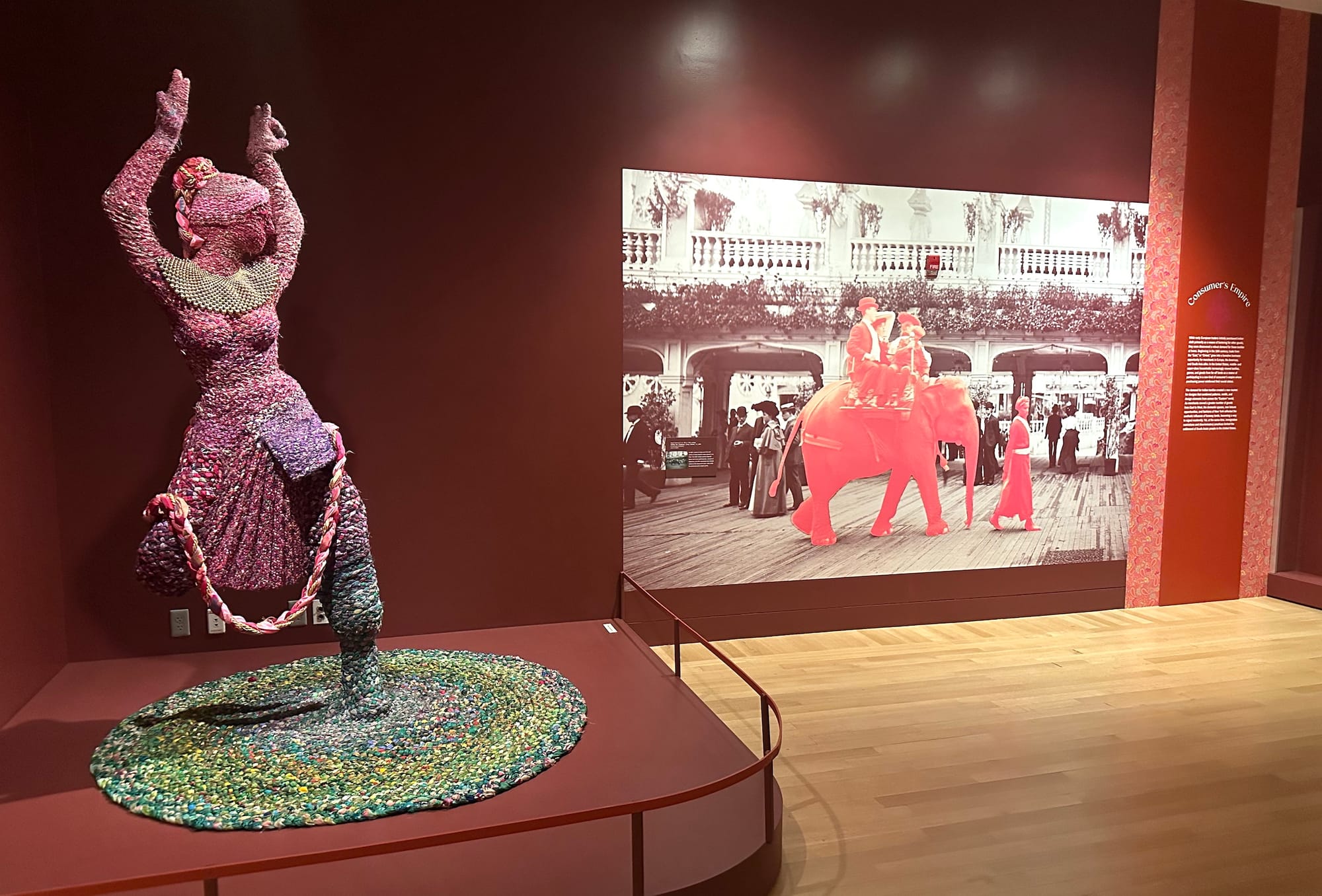
Anoushka Shankar’s sitar, Arooj Aftab’s voice, and Alice Coltrane’s harp spill into the hallway outside the one-room exhibition, on view at the New York Historical through April 26. Suchitra Mattai’s “she arose (from a pool of tears)” (2024), a Bharatnatyam dancer made from used and loved saris, greets visitors at the entrance. The small but mighty show serves as a primer on South Asian history in New York, framed conceptually and visually through the sari in all its infinite pleats, drapes, and patterns.
Co-curators Salonee Bhaman and Anna Danzinger Halperin, director of the Center for Women’s History at the museum, did not set out to craft a definitive history of a decidedly complex garment and community. “I knew going into working on this show that there was no singular story of the sari, and that there were particular things that a diaspora experience brings out of the garment,” Bhaman told Hyperallergic in an email. That self-awareness frames the exhibition not as an airtight artifact but as a site of living, breathing contemplation.
Suchitra Mattai's "she arose (from a pool of tears)" (2024) on left, with a reproduction of a 1905 photo of tourists riding an elephant at Coney Island, with a South Asian handler guiding it across the boardwalk
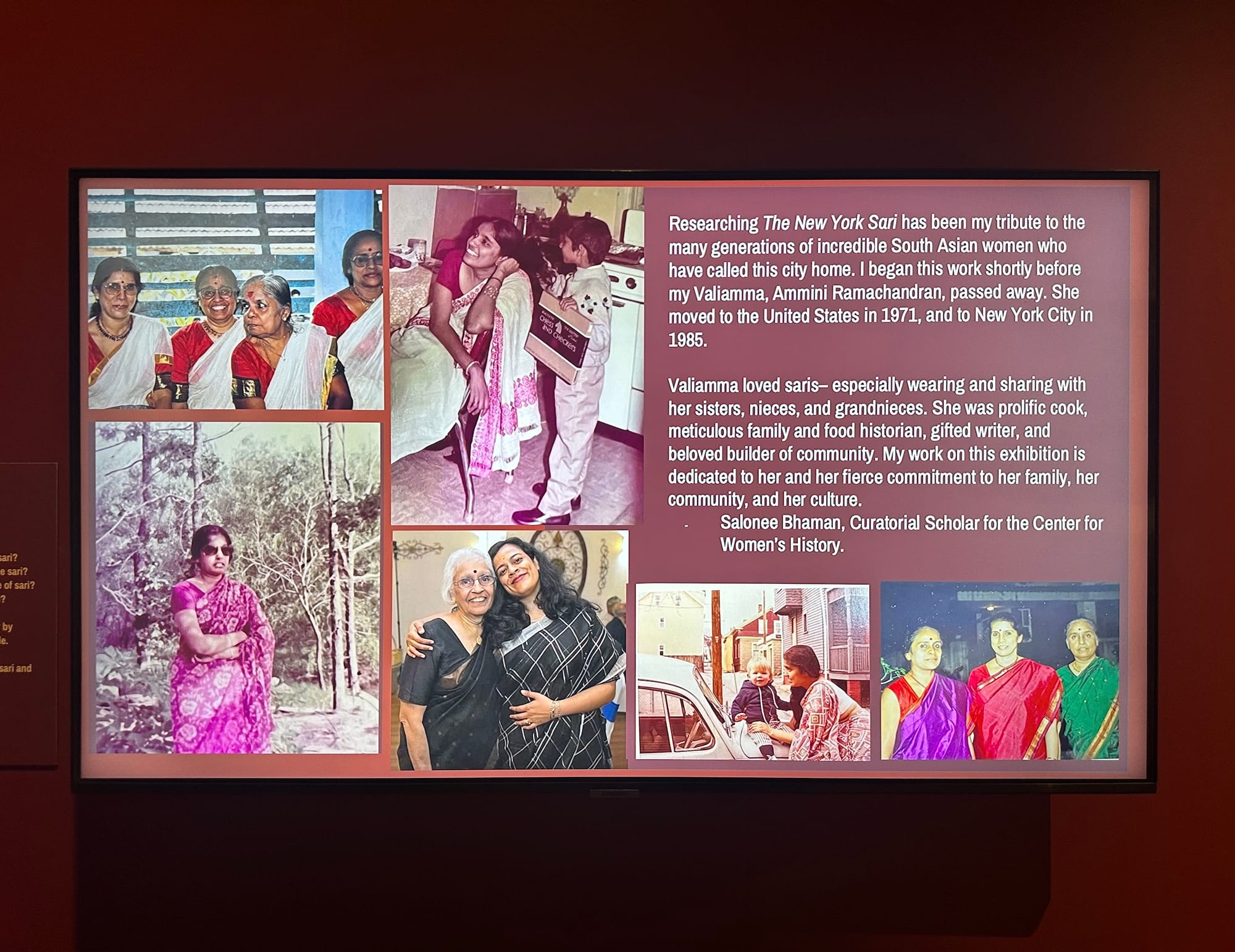
A scholar of social movements and founding member of the Asian American Feminist Collective, Bhaman first moved to the city from India to attend Columbia University. She recalls that professor Gayatri Spivak “frequently appeared in a sari while grading papers or meeting with students on campus,” a deliberate choice that reminded her of home and fueled her imagination as a historian.
“There is always a battle for self-definition within any diaspora,” Bhaman said. “In my experience, there’s a lot of asking, ‘Who are we to the outside world and to each other?’ It’s important to allow the full richness of that conversation to come through in a history exhibition.”
Co-curator Salonee Bhaman's testimony
With pieces by artists like Chitra Ganesh and Shradha Kochhar mingling with saris, printed ephemera, videos, and other historical materials, the result is not a static archive; it’s an unfinished weave of South Asian life in New York City. The show reminds us that the garment is a living art form, an heirloom, a document, and a political statement in one.
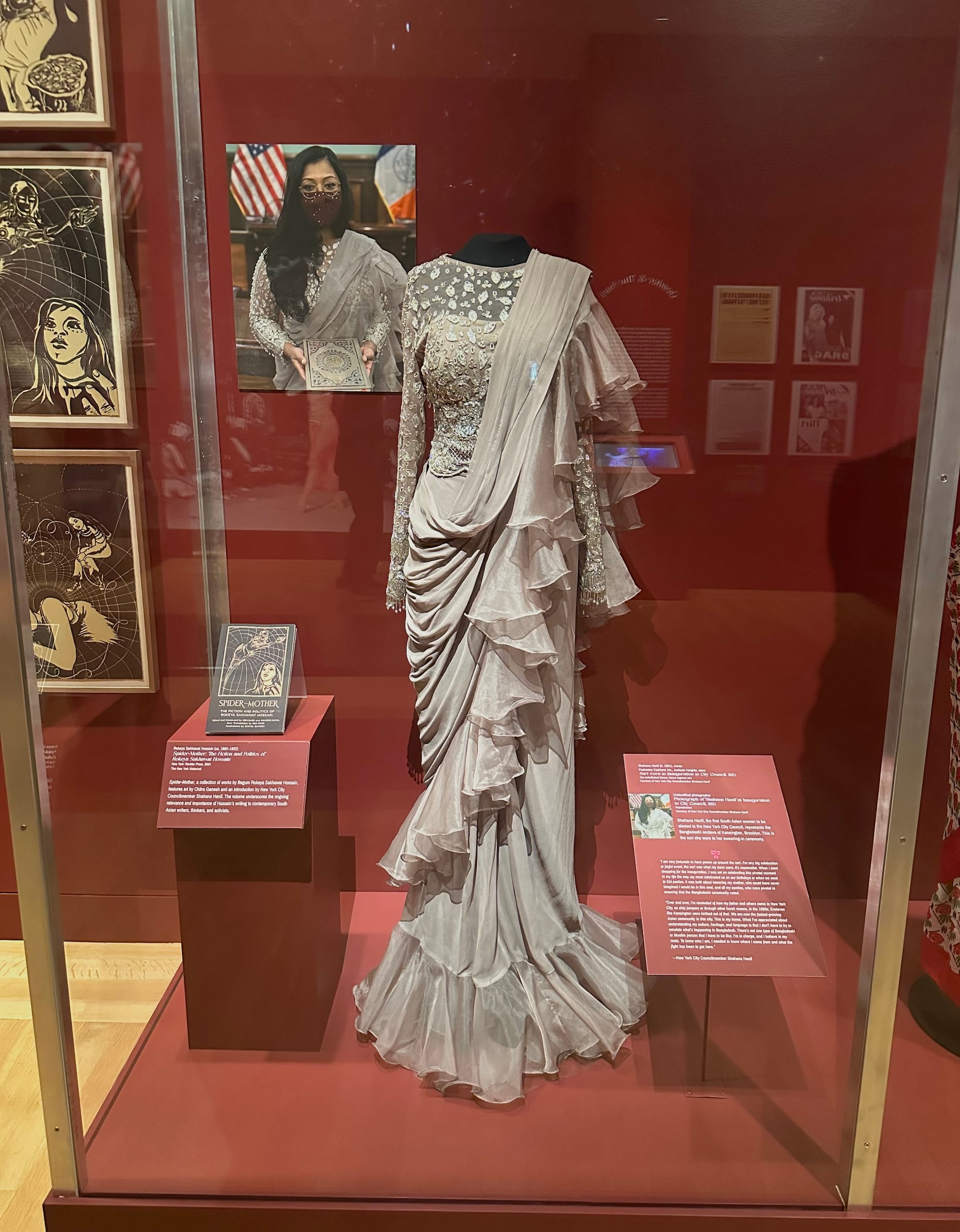
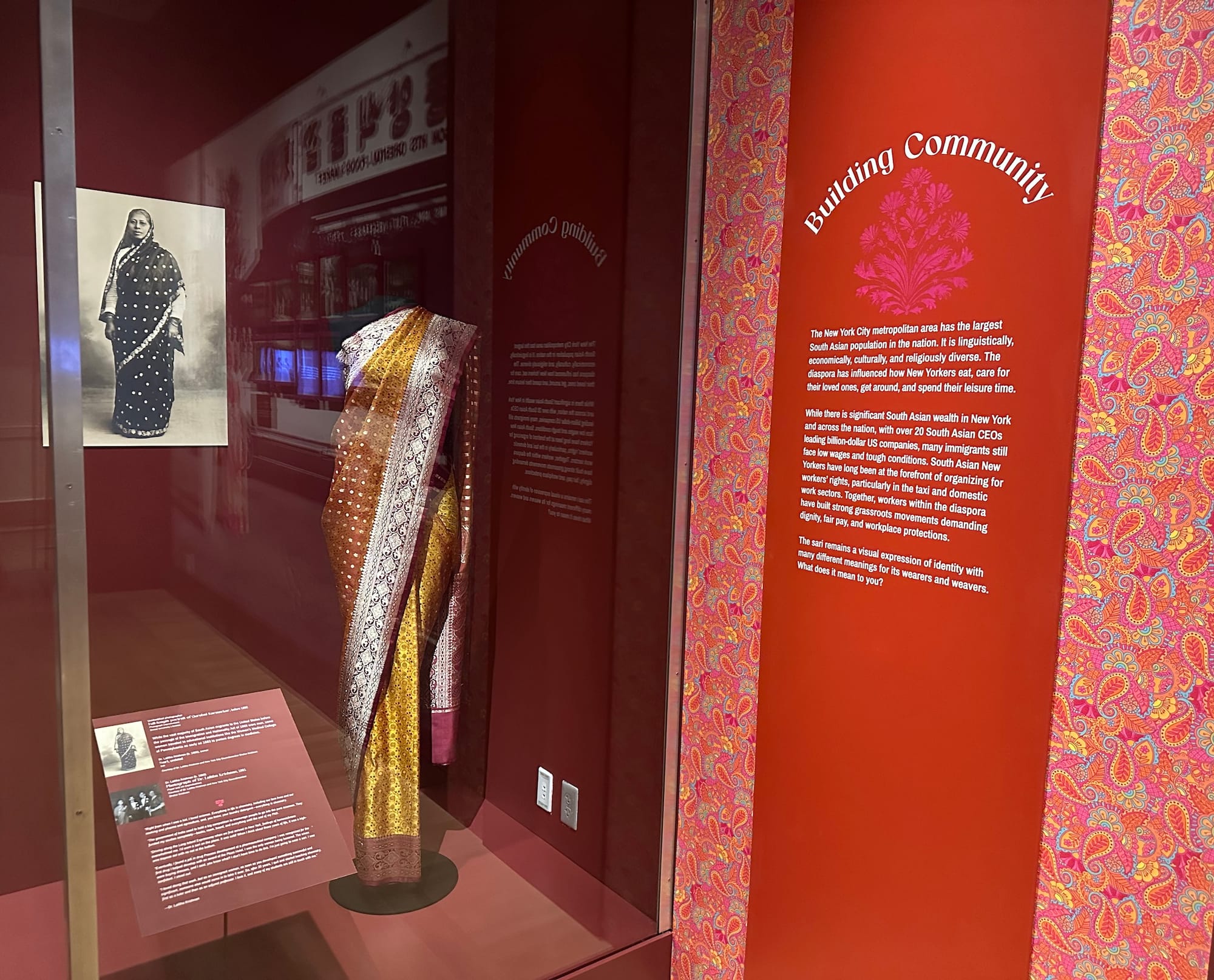
The sari’s traditional form makes relatively few appearances, which seems to be by design. We see the elegant sari worn by Shahana Hanif, the first Muslim and Bangladeshi woman to serve as a New York City councilmember, during her swearing-in ceremony in 2021, and a zerzet sari from Nepali-American organizer Narbada Chhetri. Nearby is an orange-and-red silk sari belonging to Malayali immigrant Dr. Lalitha Krishnan, whose son, Councilmember Shekar Krishnan, originated the idea for the exhibition over two years ago in dialogue with museum staff and journalist S. Mitra Kalita. All are framed in the context of the craft itself, practiced primarily by women whose labor goes chronically overlooked at best and exploited at worst.
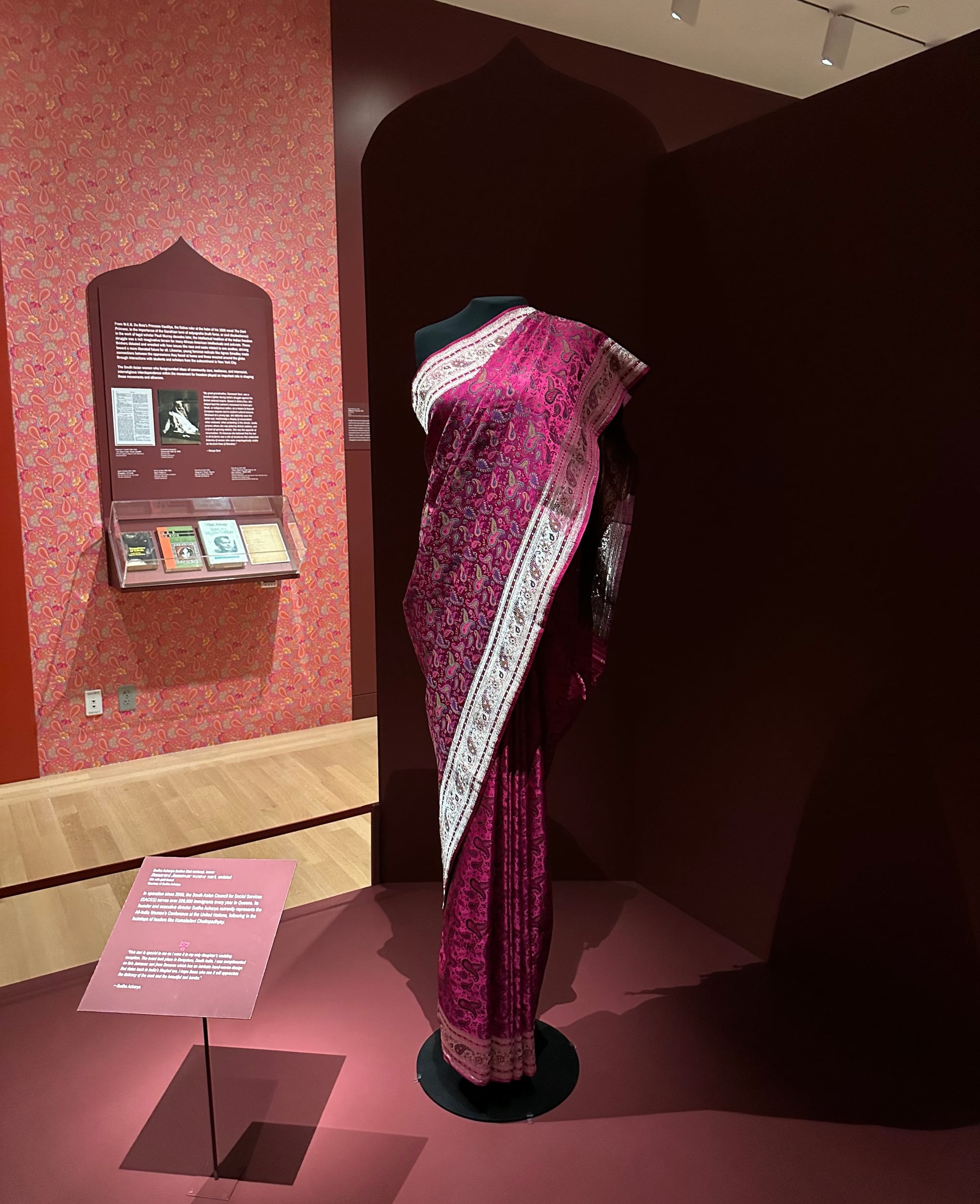
Left: A Banarsi Jamawar weave sari owned by Sudha Acharya, the founder and executive director of the South Asian Council for Social Services; right: The net-embellished and tissue organza sari from Pashmina Fashions Inc. in Jackson Heights that Shahana Hanif wore to her city council inauguration in 2021
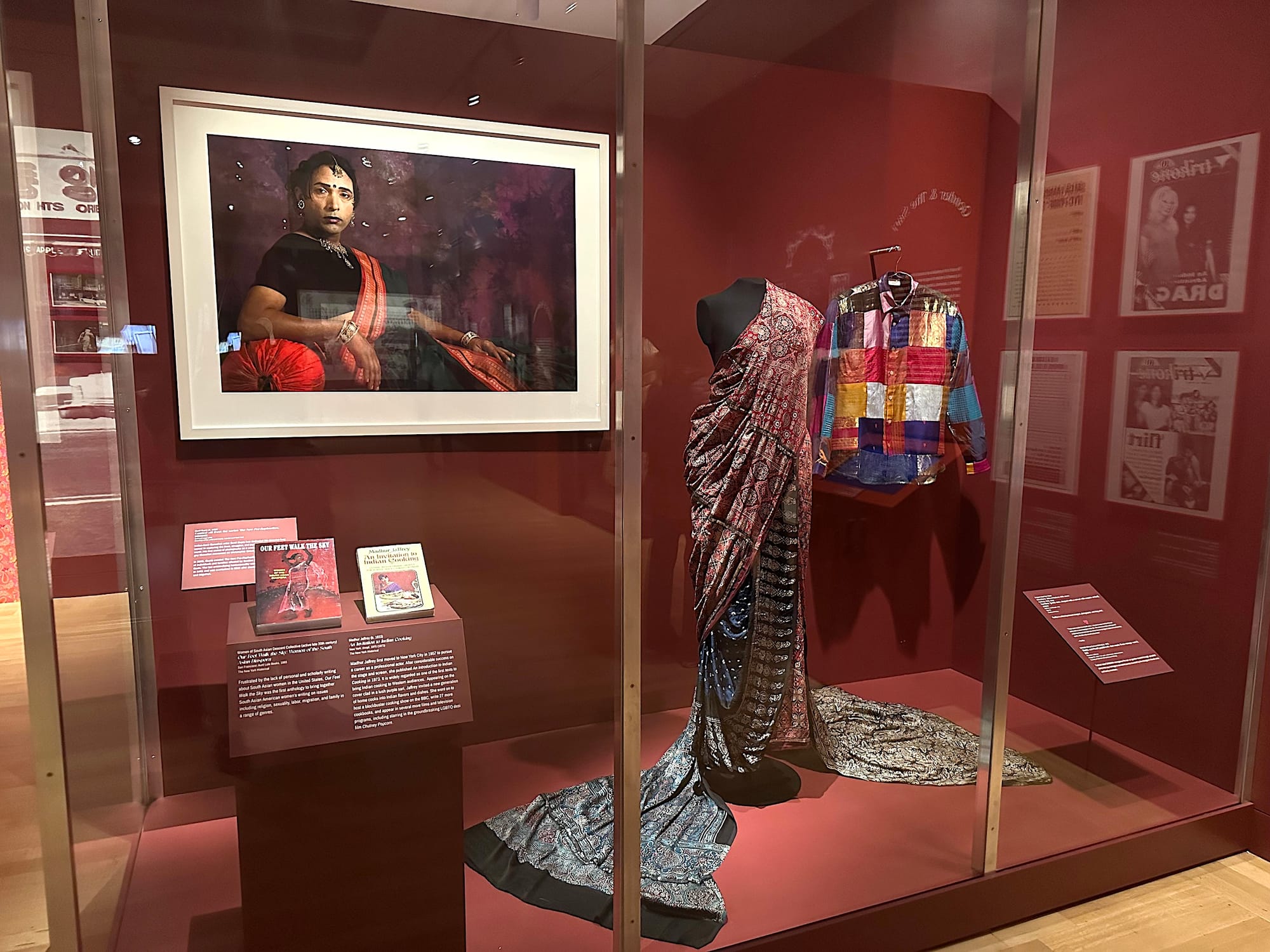
These drapes converse with a display across the room on the relationship between gender, sexuality, and the sari, a crucial component of the garment’s ongoing life that, like LGBTQ+ history in general, too often gets erased in South Asia and its diaspora. A remarkable double-sari owned by Brooklyn-based photographer and drag artist RuAfza, who joined two Ajrakh saris from Gujarat as a single garment and embellished it with sequins. A portrait from Indian-Canadian photographer Sunil Gupta’s groundbreaking series The New Pre-Raphaelites (2008) takes aim at the now-overturned British colonial law criminalizing homosexuality, replacing figures in paintings from the 19th-century English art movement with queer Indian people.
Retellings of South Asian American history too often gloss over the very real strains of conservatism in the diaspora or erase the meteoric rise of the global Hindu right.The sari itself is entangled in these movements, often wrongly characterized as a symbol of “Hindu identity.” In the 1970s and ’80s, General Muhammad Zia-ul-Haq discouraged Pakistani women from wearing saris due to their false association with Hinduism and the nation of India, prompting younger generations to reclaim the garment in recent years.
A silk sari owned by Dr. Lalitha Krishnan next to a circa-1892 photo of Dr. Gurubai Karmarkar, one of the first Indian women to earn a medical degree in the United States
While some of the displays and wall texts include familiar flashpoints in South Asian American history, like the 1965 Immigration and Nationality Act, the curatorial framework of saris as storytellers disrupts the many forms of oppression that fester in the diaspora — casteism, patriarchy, Islamophobia, homophobia — by pulling on a single common thread.
“We knew that there was no way we could capture the full breadth, the full multiplicity of what a sari means in the city,” Danzinger Halperin told Hyperallergic in an interview. “It was really important to us to have a call for participation as part of the exhibition.” That invitation to submit personal stories and photos through a Google Form — some of which appear in a slideshow in the exhibition — reflects the project’s animating force.
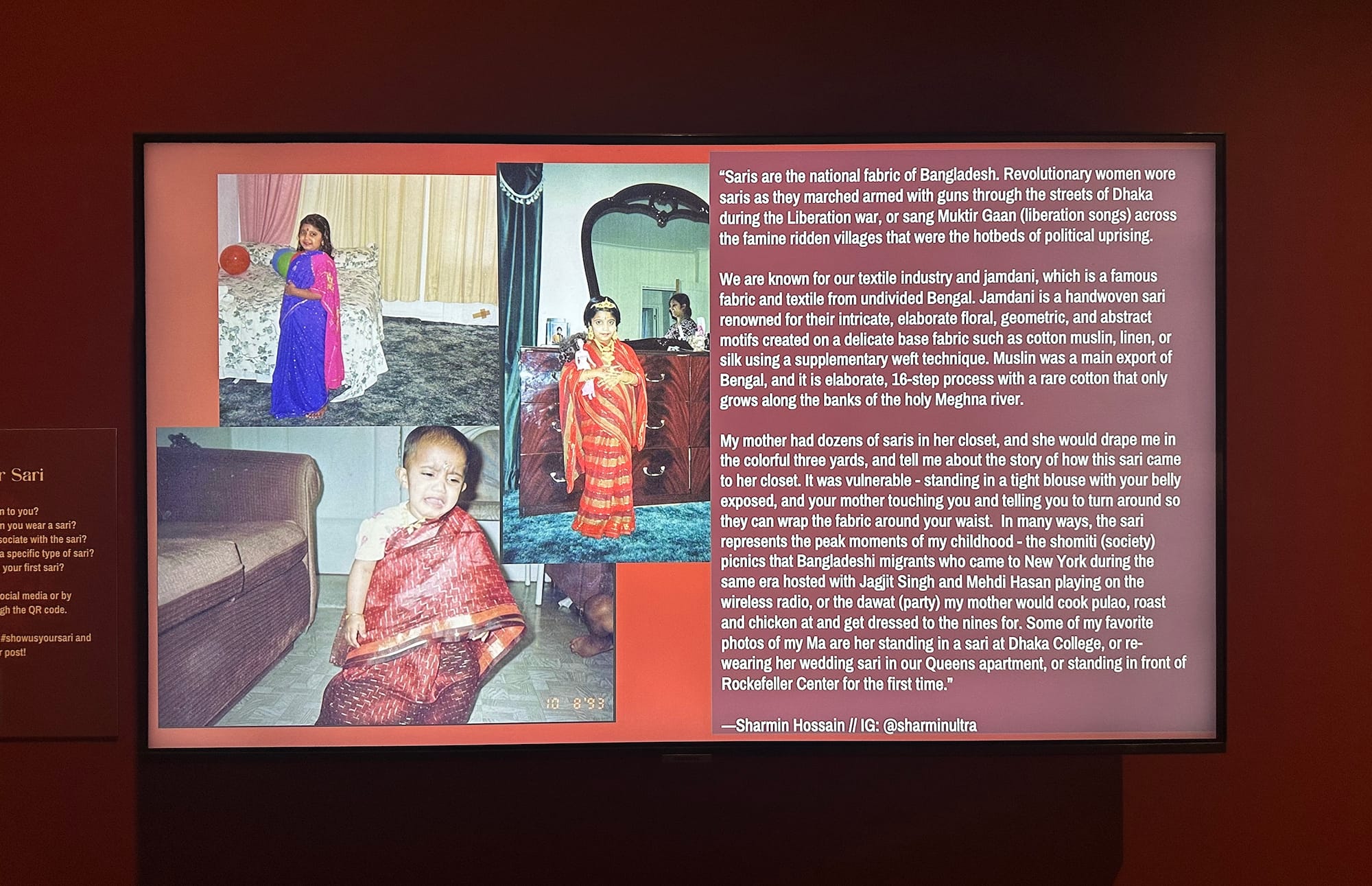
Among these community-sourced testimonies is one from Bangladeshi-American artist and organizer Sharmin Hossain, who said in an email to Hyperallergic that The New York Sari is a rare chance to see South Asian femmes celebrated as “protagonists.”
Sharmin Hossain's testimony
“The sari is woven into the history of Queens, where in that borough alone, we are more than 8% of the population,” Hossain said, adding that the show emphasizes the power of South Asian progressive organizing in New York City. “Zohran [Mamdani]'s win was only possible because of the grassroots organizing led by organizations like Desis Rising Up and Moving and CAAAV.”
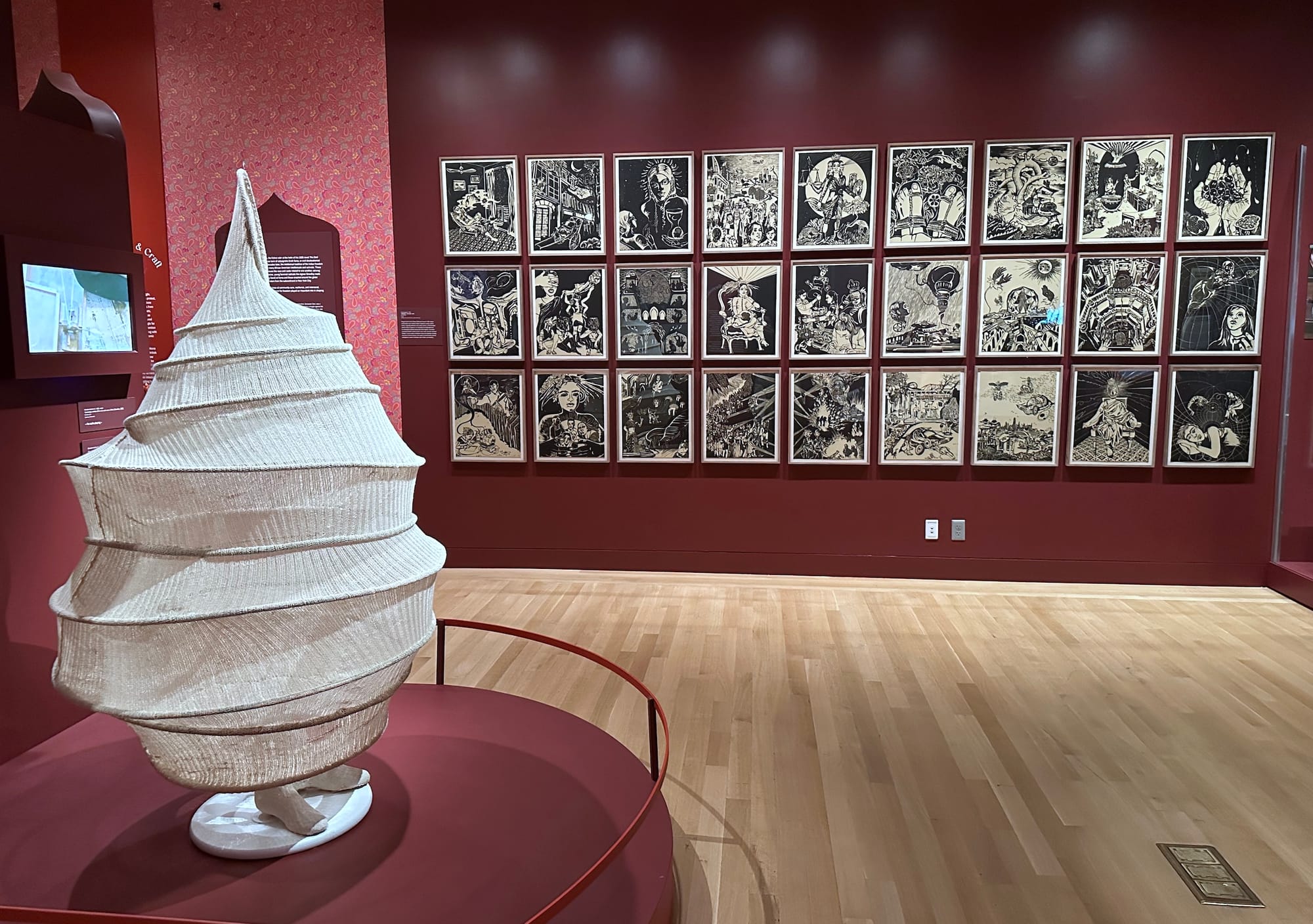
Shradha Kochhar's "Rest/Release" (2025) on left and Chitra Ganesh's Sultana's Dream (2018), 27 linocuts, in the background
Mamdani’s historic win was indeed preceded by decades of advocacy, including by NY Taxi Workers Alliance Director Bhairavi Desai, captured donning a sari in front of Manhattan’s Haandi restaurant in a 2011 photograph by Martha Camarillo. Elsewhere, Philadelphia comic artist Shebani Rao narrates Indian activist Kamaladevi Chattopadhyay’s 1939–41 visit to the United States in a series of panels, highlighting her efforts to connect the struggle against British colonialism with the Civil Rights movement. She was also an outspoken advocate for the scores of artisans across India, mostly women, who carry craft and textile traditions forward yet have few rights and protections, if any.
Ganesh, whose 2018 linocut series Sultana’s Dream unfurls a sci-fi epic across one wall, was struck by the way “interweaving archival materials with contemporary art refuses exoticism and nostalgia” across the exhibition.
“This incredible mix of queer archival materials like posters and drag performance … extends well beyond the sari itself,” Ganesh reflected.
Sunil Gupta's "Untitled #13" from The New Pre-Raphaelites (2008) on left, with a two-sided sari owned by RuAfza and SAMAVAI's gender-neutral sari patchwork top "Thatha and Paati" (2025) on right
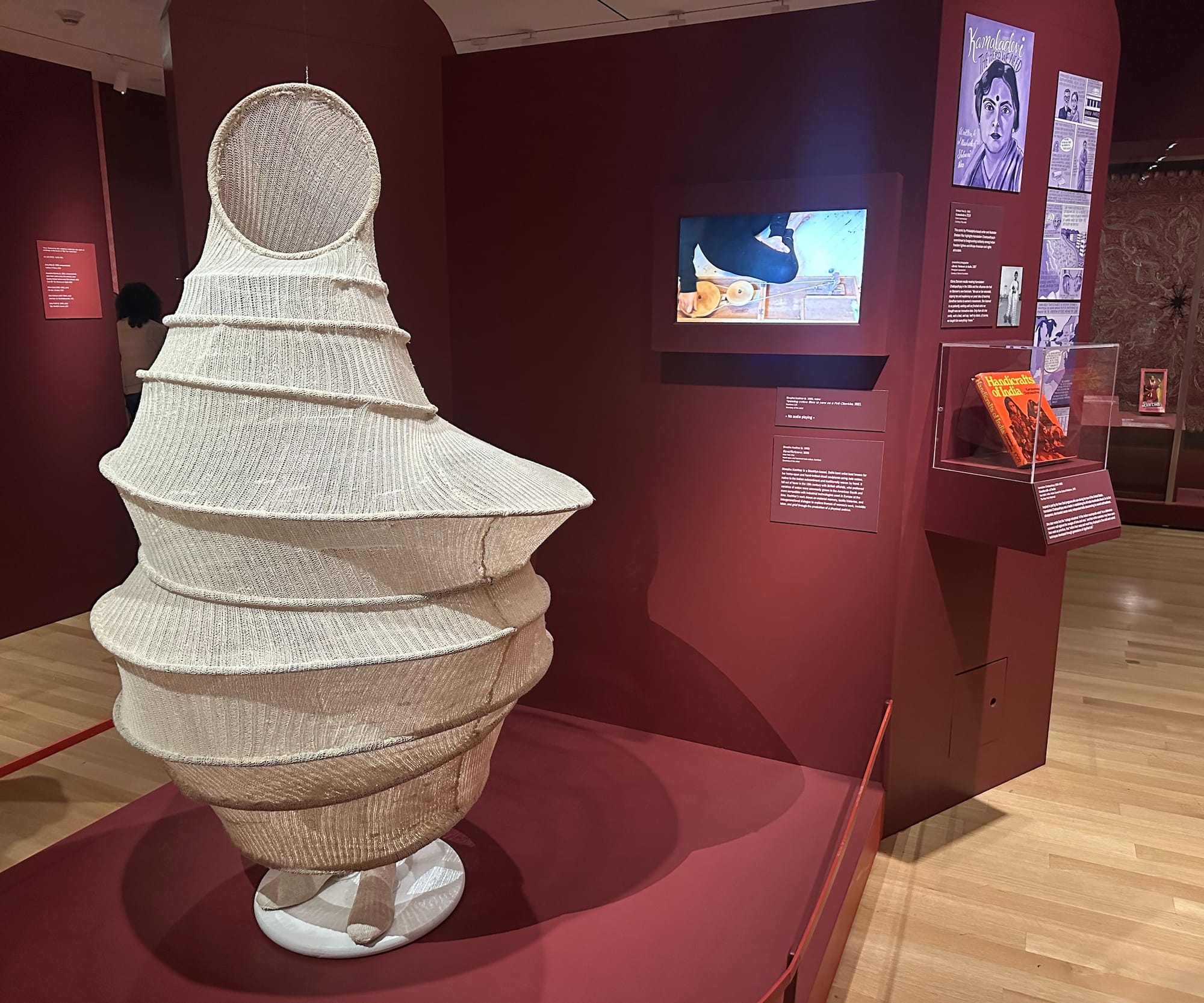
Danziger Halperin recalled that the curatorial team originally inquired about Kochhar’s sculpture “I’m cocooning” (2021), but the artist wanted to make something new. “Rest/Release” (2025), the show’s gravitational center, is a “meditation on rest, refuge, and the quiet architectures migrants build for themselves,” as Kochhar described it in an email. The artist says she handspun and hand-knitted the piece using kala cotton, a strain endemic to India that declined after the British colonial market decimated local textile industries, to make “a vessel large enough to hold a body.”
Kochhar’s quietly defiant sculpture echoes the movement implied in Mattai’s, as well as footage of performances by the Nadanamandalam Collective (നാടനമന്ദലം). In a short film by Nikita Shah, drag artist LaWhore Vagistan dons a chest mold by Misha Japanwala and hypnotically intones, “The textiles perform with me. They move under the light. They tell their own story.”
“Having this work in a shared space feels like a small reclamation; a way of saying that our materials, our griefs, our joys, and our politics are here, and they will continue to take up space whether or not the world makes room for them,” Kochhar added.
Shradha Kochhar's "Rest/Release" (2025)
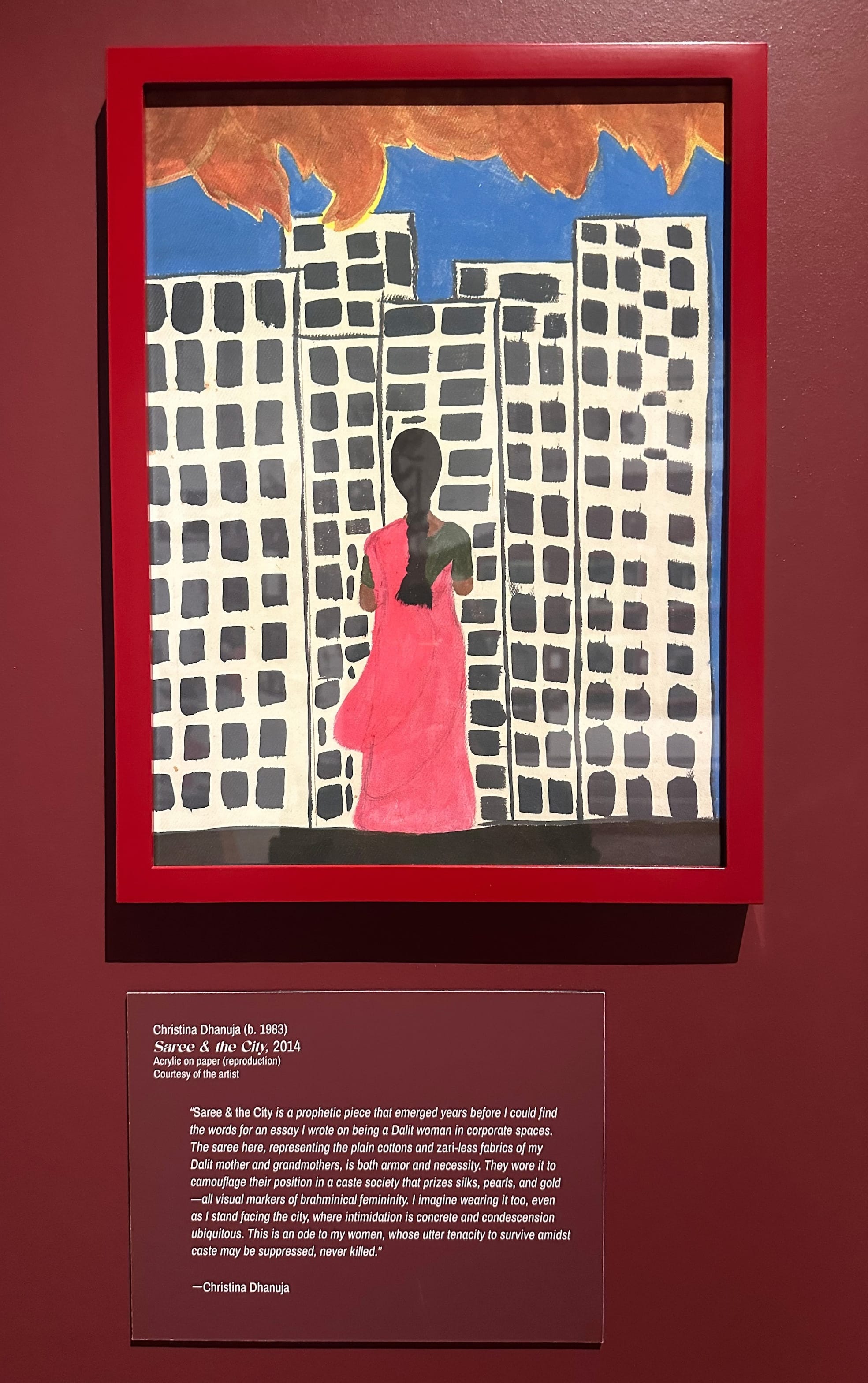
Writer Christina Dhanuja, co-founder of Dalit History Month, contributed what she calls a “prophetic” portrait of herself wearing a sari and facing the expanse of the New York City skyline.
“Perhaps I anticipated the condescension that would come my way, and the plain, pink saree symbolizing my resilience, even as I’d stand facing a city’s intimidation,” she said in an email to Hyperallergic, referencing the discrimination she faced as a Dalit woman in corporate America. Dhanuja has long been outspoken about casteism as “deeply alive” yet routinely erased and denied in South Asia and the diaspora.
Christina Dhanuja's "Saree & the City" (2014), acrylic on paper reproduction
“Caste, intertwined with class, is what shapes access to creative spaces. Which is why naming it is crucial,” Dhanuja continued. “It allows us to sit with the discomfort of South Asian histories being complex, and often complicated, struggles for equality, status, and self-determination.”
The New York Sari offers just that — one attempt to honor the complexity of a kaleidoscopic garment “without smoothing over the rough edges that are part of all honest history work,” Bhaman said.
The Israeli Defense Forces killed a Palestinian couple and two of their children in the West Bank on Sunday, on one of the deadliest days for Palestinians in Gaza and the West Bank in weeks. The soldiers opened fire on a car in the village of Tammun in which 37-year-old Ali Khaled Bani Odeh, his 35-year-old wife Waad, and their four sons Mohammad, Othman, Mustafa, and Khaled were traveling.
President Donald Trump wondered if the U.S. “shouldn’t even be there” when answering questions about the war on Iran on Sunday, claiming that Iran’s military is already totally obliterated as the U.S. and Israel’s bombardments enter their third week with no end in sight. A reporter asked Trump on Sunday about his demands that other countries aid him in trying to force transit through the…
Israel announced on Monday that it is expanding its ground in southern Lebanon, claiming to target Hezbollah as Israel’s defense minister pledges that “hundreds of thousands” of people already forcibly displaced by Israeli attacks “will not return” for the indefinite future. In a statement, Israeli forces said that soldiers are carrying out “limited and targeted ground operations” in…
As the U.S. and Israeli war on Iran extends into a third week, President Trump is demanding other countries send warships to the Strait of Hormuz, which has been largely shut, as oil prices keep rising. This comes as the U.S. and Israel continue to launch major strikes on Iran, while Iran has retaliated by repeatedly striking Israel and U.S. allies in the Gulf, including the United Arab Emirates…
Last week, the New York Academy of Art (NYAA) told its students and alumni that it will donate $65,900 in funds associated with sex offender Jeffrey Epstein to an organization supporting survivors of sex trafficking.
In an email reviewed by Hyperallergic, the NYAA board admitted to “serious failures in judgment and governance” inthe school's continued relationship with the disgraced financier after his 2008 conviction for soliciting a minor for prostitution, new details of which were recently revealed in the latest release of Epstein files.
“As we noted in our letter to our Community and as we have said previously, the Academy apologizes for and regrets its past association with Mr. Epstein, which ended well before his arrest in 2019,” NYAA said in an emailed statement to Hyperallergic. The school also said it will develop an ethics committee to review and recommend policies for institutional donor support.
The graduate-level private school, co-founded in 1982 by Andy Warhol and Stuart Pivar, said that $65,900 in contributions Epstein made to NYAA events in 2012 and 2014 will be donated to Girls Educational and Mentoring Services (GEMS), a nonprofit for girls and women who have survived commercial sexual exploitation and domestic trafficking.
Farmer has stated that then-NYAA Dean (and current board chair) Eileen Guggenheim introduced her to Epstein, who sat on the Academy's board from 1987 to 1994, and Ghislaine Maxwell during her thesis show in 1995. Guggenheim allegedly instructed her to sell Epstein one of her paintings at a discount. Shortly after, Epstein hired Farmer as an art advisor and property manager for the Manhattan townhouse he purchased from his client, billionaire retail tycoon Leslie Wexner.
Farmer used Epstein's Ohio residence as a studio space to complete an external commission in the summer of 1996, during which she alleged that Epstein and Maxwell had sexually assaulted her and had stolen nude photos of her underage sisters that she intended to use as artistic references. The artist left the residence and learned that her younger sister Annie, then 16, had also alleged that Epstein and Maxwell had inappropriate sexual contact with her when she visited Epstein's New Mexico ranch that same year.
When Farmer returned to New York, she filed a report against Epstein and Maxwell with the Federal Bureau of Investigation, which went ignored for a decade. Epstein ultimately pleadedguilty to the state charge of soliciting a minor in 2008 and was incarcerated for 13 months in Florida while reaping the benefits of a work-release program.
The trove of Epstein files released in Januaryrevealedthat the financier purchased a $25,000 table for the Academy's annual Tribeca Ball fundraiser event in 2012 and 2014. He also donated $30,000 to the Portrait Scholarship fund in 2014 per an invitation from Guggenheim. Several emails indicate that Guggenheim encouraged Epstein's relationship and contributions to the school.
The NYAA acknowledged the specific incidents of Epstein's support in its email to students and alumni, stating that “the Academy should not have accepted these contributions from Epstein, nor allowed him to attend Academy events such as Tribeca Ball or Take Home a Nude.”
“He should not have been permitted to participate in the Portrait Scholarship program or to visit the school,” the board's message continued. The email also outlined that Guggenheim will prepone her planned retirement as the board chair by one month, opting to leave this coming April instead of May.
The latest Epstein file drop has shed light on the sex offender's connections throughout arts and culture institutions. Last month, David A. Ross resigned from his role as the MFA Arts Practice chair at the School of Visual Arts after several email exchanges revealed his support for Epstein years after his 2008 conviction. The tranche also yielded new details on allegations of sexual violence by billionaire and Museum of Modern Art trustee Leon Black.
WASHINGTON, DC — Lorena Bradford set out to be a speech-language pathologist, but she fell in love with art history, going on to earn a PhD in 17th-century Dutch and Flemish print-making. It would not be until 2010, however — two years after she started working as an educator at the National Gallery of Art (NGA) in Washington, DC — that she learned about arts accessibility, when she attended her first Leadership Exchange in Arts and Disability (LEAD) Conference.
At the time, she was "confronting my own assumption that speaking equals engagement,” Bradford said over Zoom in January. As more autistic children were visiting galleries as part of school programming, she began asking questions about creating programs intentionally tailored for disabled students and adults. Soon after, she was hired as the first head of Accessible Programs at the NGA.
Many other museums lump together reasonable accommodations for patrons and staff along with Americans with Disabilities Act (ADA) compliance into one person’s job description, but Bradford was able to focus on tailoring programs to patrons’ needs and wants.
“I was a sub-department of one,” she joked.
Lorena Bradford at the National Gallery of Art in 2025
In the years that followed, she started a monthly tour in American Sign Language led by deaf guides, alongside a program for individuals with memory loss and their caregivers called Just Us, which ran from 2017 to 2024. She also established a program that brought Georgetown medical students into the gallery to learn skills that would enhance the care they provide, including observation, communication, compassion, and perspective.
But one of her biggest endeavors was the Short Description Project. Many museums, including the National Gallery of Art, had recorded verbal descriptions of art for in-person patrons, but this was a different level of accessibility. “One of the things that’s really amazing is that you put everything online,” Bradford explained. “There’s no paywall and that’s a huge part of accessibility, getting to access information online.”
Begun during the COVID-19 pandemic, when many museums were thinking about digital access, the Short Description Project developed a workflow for creating detailed written descriptions for all individuals encountering art online. This meant sketching out parameters for how long the descriptions could be, what should be included, what language used, what reading level they should be, and what process and training might look like, all from the ground up.
Lorena Bradford at the National Gallery of Art in 2025
The Trump administration, however, changed everything. While most accessible program work was and is still intrinsically connected to visitor services and protected by the ADA, “the strides that I and colleagues from across many, many museums were making related to diversity, equity, inclusion, and accessibility were curtailed or stopped,” Bradford said.
Two years ago, she began undergoing cancer treatment and dropped her hours at the NGA to part-time. She officially left the museum this past July.
But her passion for access never stopped. Now, she works as an audio describer at the Kennedy Center, writes alt text and image descriptions for Scribeley, teaches art history courses at a local community college, and curates all of the content for the LEAD conferences.
Lorena Bradford at the National Gallery of Art in 2025
Bradford knows that her educational and career path is unconventional. As more museum education programs come into being, “there’s not necessarily a place you can go to learn to do cultural accessibility like what we’re doing in museums and theaters,” she said.
She looks forward to the day — which she believes will be sooner rather than later — when arts accessibility will not only be a distinct, formalized educational path, but there will be ways to accredit people in arts accessibility programming, services, and coordination.
“[Art is] a universal language, and everyone should have access to it," Bradford said. "You don’t have to speak a foreign language to look at a painting made in a different country, or to listen to a piece of music. As a universal language, it should be accessible to the universe.”
Several allies to the U.S. have rebuffed President Donald Trump’s demands and threats this weekend for countries to aid in opening transit through the Strait of Hormuz, as oil prices spike in the third week of the U.S. and Israel’s war on Iran. As of Monday morning in the U.S., no countries had committed to aiding in Trump’s plan to form a naval coalition for access to the strait as Iranian…
Josué Aguilar Valle, a Honduran national, recalls the “terrible” conditions at the migrant jails where U.S. immigration authorities imprisoned him last year. In La Salle County, Texas, Aguilar shared a frigid cell with 50 men, sleeping on the concrete floor. “I thought I was going to experience hypothermia,” he explained. Aguilar’s wife struggled to locate him…
In an interview with The Wall Street Journal last week, President Donald Trump suggested that his main criterion for deciding when the war in Iran will end is his own feelings. Beyond failing to recognize the fact that any war with foreign countries requires approval or authorization from Congress, Trump’s remarks indicate that he has no sound reason for fighting the war in the first place…
US President Donald Trump late Sunday floated “treason” charges against media outlets that he accused of reporting false information about the Iran war as the human and economic costs of his illegal military assault continued to mount. In a tirade posted to his Truth Social platform, Trump wrote that media outlets he accused of circulating “fake news” should “be brought up on Charges for…
![[personal profile]](https://www.dreamwidth.org/img/silk/identity/user.png)
![[syndicated profile]](https://www.dreamwidth.org/img/silk/identity/feed.png) hyperallergic_feed
hyperallergic_feed